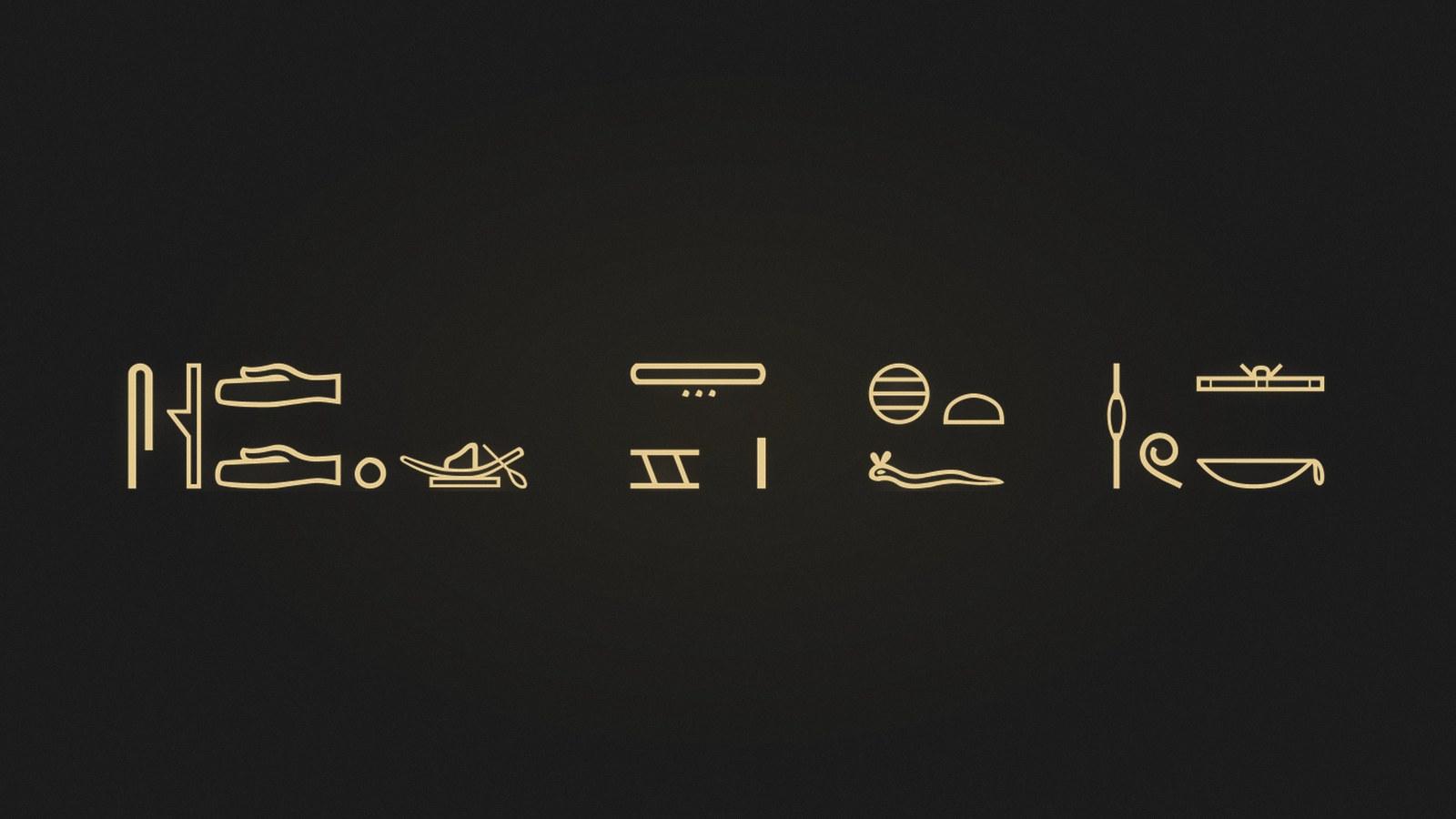
The last lesson met the sḏm·f that doubles a letter, which Alan Gardiner calls the imperfective sḏm·f and ties to repeated or continuing action. The thirty-ninth lesson ended by noting that James Allen's relative forms without an ending have another use. This lesson takes it up: the emphatic sentence, where the stress falls not on the verb but on "where", "when", "why" or "how". On this the two grammars differ.
Jill likes to sing in the shower normally tells what Jill does, Allen explains; with the stress on the last words, it tells where she likes to sing. That she likes to sing is then given, the theme, and "in the shower" is new, the rheme, which English can also mark with a cleft sentence: It is in the shower that Jill likes to sing. A sentence is "emphatic", he says, when its predicate is not part of the rheme. With a verb, Egyptian can show this by using a relative form without an ending, which Allen calls non-attributive, in place of the normal verb form, so emphatic sentences "are actually sentences with a 'de-emphasized' predicate".
This is not the stress of the thirty-sixth lesson, which moved a word to the front, nor of the thirty-eighth, "it is god who makes prosperity", which Allen counts as stressing the subject. Here the stressed phrase stays in its usual place, and the verb changes its form.
It is as you command
In the Eloquent Peasant a man is addressed, "Thou art the rudder of the entire land", and then:

sḳdd, "sails", has the folded cloth, a bricklayer's tool read ḳd, two hands, a circle and a boat. Allen reads "it is as you command that the land sails": that the land sails is given, and what matters is that it does so "as you command". The doubled d shows it: the ordinary active sḏm·f of sḳdi, "sail", does not double, so sḳdd "can only be a relative form". Gardiner lists the same words under the imperfective sḏm·f, among statements of custom, as the "Characterization of a person".
Where and why
The easiest to recognise, Allen says, are questions. "Interrogative words are always the rheme in any sentence", and when the question word is an adverb or a phrase with a preposition, the verb is a relative form, as in ms·s irf s(y) nw, "at what moment will she give birth?", from the twenty-sixth lesson. Gardiner gives this one too:

i·n·ṯn is "you have come", with the reed and walking legs of ii, "come"; tn, "whence?", ends with a throw-stick, a duck and a road. In Allen's source the answer has the same shape: "It is from the well of Ibhyt that we have come".
Gardiner keeps the twenty-sixth lesson's rule, that a question word stays where the answer would go, but comes close to Allen here. In questions, he writes, "emphasis naturally rests on an interrogative adverbial adjunct", and the doubled sḏm·f "may then introduce a virtual noun clause as subject". With tm, the negative verb of the thirty-third lesson, both grammars quote the Eloquent Peasant:

tm·k is the sledge, the owl and the basket, tr is "pray", and ḥr m, "on account of what?", is the face and the owl over the forearm. Gardiner's literal rendering is "that-thou-dost-not hearken is on account of what?", and he adds: "English similarly says: why is it that thou dost not hearken?" Allen has "Why do you not listen?" The tm denies the verb; the question is still "why".
When, and coming
The last lesson quoted a clause of time in which, for Gardiner, the doubled form means "whenever". For Allen the whole sentence is what Egyptologists call "balanced": two clauses with relative forms that depend on each other.

ḫdd·k, "you sail north", ends with a boat, and sꜣ-tꜣ, "reverence", is a hobble for cattle and the land sign. Allen translates "Whenever you go downstream, homage is given to you". The thirty-first lesson noted that Allen also reads ḥḏ·n tꜣ, "when day had dawned", differently from Gardiner: for him such a clause can come first only through the emphatic construction, so its ḥḏ·n is a relative form.
With verbs of motion, Gardiner says, the sḏm·n·f of the seventeenth lesson is "certainly preferred" to the old perfective, the stative of the eighteenth, "when any stress is laid on the movement as an action performed by someone; such a stress occurs, for example, when words indicating the purpose of the movement are added":

With such verbs, he concludes, "the sḏm·n·f form emphasizes the fact of the movement, while the old perfective merely calls attention to the result". Allen turns this round. Since Egyptian uses the stative for completed action with verbs like "go", their sḏm·n·f "is normally a non-attributive relative form", and the stress lies on what goes with it: "It was with a force of 3000 men that I went up."
Two accounts of one form
Allen tells the history. In 1944 Hans Jakob Polotsky explained the "Second Tenses" of Coptic, the latest phase of Egyptian, as forms used in emphatic sentences, showed that Gardiner's imperfective sḏm·f appears in many of the same kinds of sentence, and argued that it was "a special use of the imperfective relative form". Allen keeps "Polotsky's original idea that they are special uses of the relative forms", though not his view that the stressed phrase is grammatically the predicate.
Gardiner did not accept the theory. In the preface to his second edition he writes, "I have been unable to persuade myself of the necessity of abandoning any of my main positions, particularly in respect of the theory of the verb", and refers to his reply to "Polotsky's able assault". In the grammar he grants that "emphasis often does seem to rest on an adverbial adjunct", but holds that in his main clauses of custom and rule "a notion of repetition or continuity is invariably present", and that some lack an adverbial phrase altogether. He concludes that "the utmost that can be conceded to the new theory" is that the form "was specially prone to be used as a noun". His additions note R. A. Parker's demotic evidence for Polotsky's theory, "but I see no reason for modifying my own statement on the subject".
Allen's own test is a good habit for the texts ahead: if "it is ... that" fits an Egyptian sentence better than a plain statement, the stress probably lies outside the verb.