The last lesson used the infinitive as a noun. This one shows how Egyptian says "not" with it, and with most other parts of the verb. Negation has come up often in this series: n and nn in the ninth lesson, n sḏm·f, "he did not hear", in the seventeenth, nn wi ḥr sḏm st in the nineteenth, m, "do not", in the twentieth, iwty, "who has no", in the twenty-first and im·f sḏm, "may he not hear", in the twenty-fifth. Alan Gardiner explains why another is needed: on examination, nn and n are "almost confined to statements and to certain virtual subordinate clauses derived from these". To negate other kinds of clauses, and the parts of the verb that work as nouns and adjectives, "the Egyptians had recourse to what we shall term the negative verb".
In English "not" is what Gardiner calls a sentence-adverb, and so are nn and n. With the negative verb, "it is the negation which is conjugated, and not the verb which is to be negated", as if English replaced "if he does not heed thy words" with "if he nots heed thy words". The negative verb has two stems. One, imi, gave the m and im·f already met. The other, tm, is the subject of this lesson.
A verb that means "not"
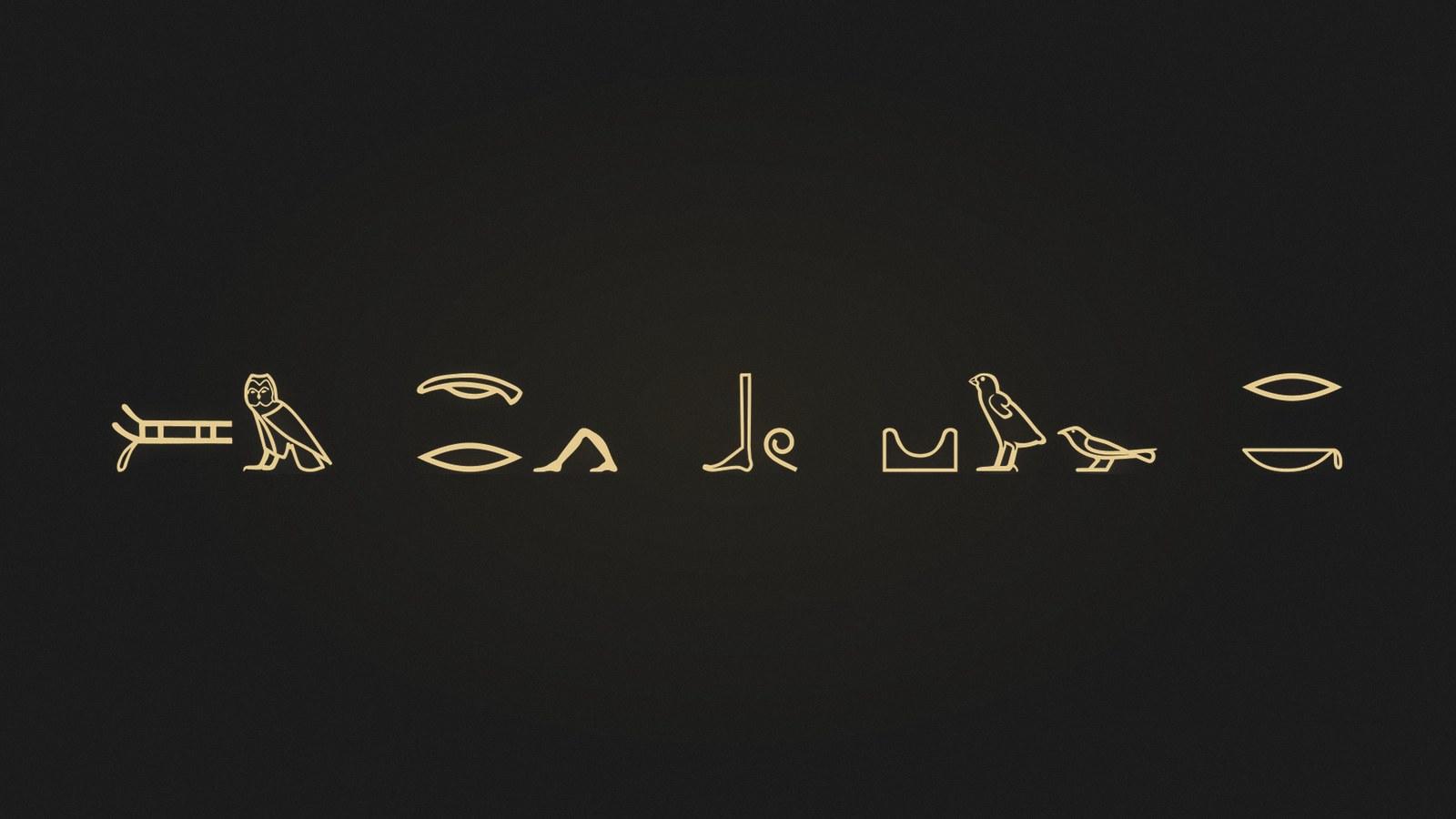
Gardiner suggests that tm meant "be complete", in the sense of "finished". tm·f sḏm would then be "he is finished (with) hearing", that is, "he does not hear". James Allen glosses it "finish, fail, not be, not do", and says it "is used more often as the negative counterpart of various verb forms than as a verb in its own right". Look for the sledge, which Gardiner's sign list reads tm. In his spelling it has a loaf above it and the owl after it, and either can be left out.
After tm comes the verb being negated, in the form the twentieth lesson met after m: the negatival complement, whose ending w is usually not written. Both grammars give the rule that makes tm so useful. Gardiner says tm "itself assumes the verb-form in question", followed by the negatival complement "or, much more rarely, by the infinitive". Allen puts it this way: "In each of its uses tm takes the same form as that of the verb form it negates."
Not to do: the negative infinitive
To negate an infinitive, "the negative verb tm is itself put into the infinitive and followed by the negatival complement". Allen contrasts English, which can negate the infinitive itself, as in "the body's not expiring". His example is the title of a funerary spell, tm m(w)t m wḥm, "Not dying again". Gardiner quotes a text that marks "the southern boundary made in year 7":

The mouth, r, gives "so as to". The sledge and the owl are the infinitive tm, and rdi, "allow", the mouth over an arm holding a loaf, is its negatival complement. A bound captive ends the word for "Nubian".
Allen notes that the subject and object of a negative infinitive follow the negatival complement, and that only a suffix pronoun is attached to tm itself. Gardiner states the rule for every form of the negative verb. There "seems to have been a reluctance to separate the negatival complement from the negative verb by any element more important than a mere suffix-pronoun", so "when the subject is a noun, this is placed, not before, but after, the negatival complement". Another spell title shows it: tm ḥwꜣ s m ẖr-nṯr, "for a man not to rot in the necropolis", with s, "man", after ḥwꜣ, "rot".
tm in the other verb forms
The twenty-fifth lesson used the sḏm·f in clauses of purpose. Their normal negation in Middle Egyptian, Allen says, is tm·f sḏm; im·f sḏm did the job in Old Egyptian. Gardiner's example is from the Eloquent Peasant, and Allen quotes the same words:

Gardiner translates "lest evil come to thee", where "lest" is literally "in order that not". The noun subject bw ḏw, "evil", which Allen explains as "a bad thing", stands after spr, the negatival complement. With a pronoun the suffix sits on tm, as in Ptahhotep's m kꜣ ib·k, tm·f dḥi, "exalt not thy heart, lest it be humiliated".
Because tm is a verb in its own right, Allen points out, it can itself be negated with nn. Both grammars quote this line of Sinuhe:

Allen gives it word for word, "He will not not do goodness". Gardiner calls it a double negative used "for emphatic assertion", where tm "is here best translated 'fail'".
The participles of the twenty-third lesson and the relative forms of the twenty-fourth work the same way: tm becomes the participle or the relative form, and the verb follows as negatival complement. Gardiner's participle example is from Ptahhotep, "it is the heart which educates its lord":

In the first half sḏm is the participle; in the second the participle is tm, with sḏm after it. Gardiner thinks it probably imperfective, but cannot be sure, because the imperfective and perfective active participles of tm look the same; Allen's table has tm mꜣꜣ for both "who did not see" and "who does not see". In a relative form, tm takes the endings:

tmt·n·(i) carries the t for a feminine antecedent, st nbt, "any place", and the n of the sḏm·n·f type; ir, "make", is the negatival complement. Gardiner's additions even give tm in the sḏm·kꜣ·f of the twenty-ninth lesson, a form Allen also lists among those it negates.
Other ways to say no
Gardiner ends the chapter with rarer modes of negation. The adjective nfr, "good", "beautiful", can also mean "finished", "at an end", which gives two idioms, nfr n and nfr pw, "there is not". The verb wdf, "delay", after ir, "if", has "practically the same meaning as a negative word". Rarest is w, an "exceedingly rare word for 'not'" placed after the verb in prohibitions. Both grammars quote one stela: "ye shall not remove this tombstone from this its place for ever".
One more form that tm can negate is the sḏmt·f, and the next lesson turns to it: the form behind "before he heard" and "until he has heard".