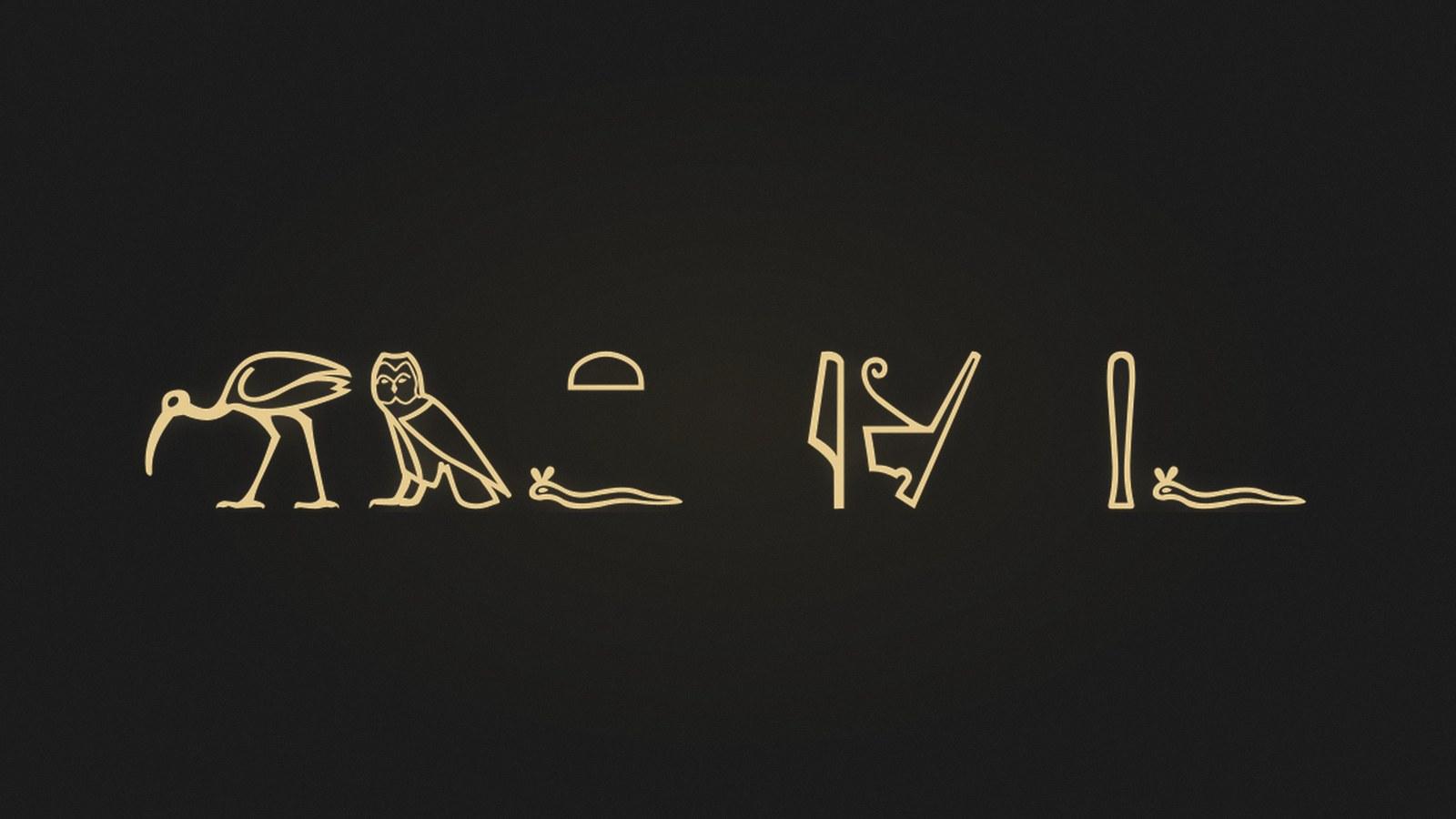
The last lesson looked at adverb clauses. James Allen notes that one construction turns up in them more than anywhere else: an infinitive after nn, the "there is not" of the ninth lesson. Alan Gardiner translates nn tšt ḥr ꜥḥꜣ "without desisting from the fight", and stresses that this is not a negative infinitive: nn means "is not", and the infinitive is its subject, a noun.
The nineteenth lesson met the infinitive as a noun naming an action, after ḥr, m and r, and the twenty-second gave its forms class by class. This lesson treats it as a noun in its own right. Gardiner notes that it differs from other nouns in being built like the narrative verb forms: it "may be followed by an 'agent'" and may even have a subject or an object of its own.
Like other nouns, it can be the subject of a sentence without a verb, of the kind met in the eighth lesson, as in Allen's mk nfr sḏm n r(m)ṯ, "Look, to listen is good for people". On number the grammars differ: Gardiner says an infinitive used as a plain noun may be put into the plural; Allen says it cannot, and is always masculine.
Who does it, and to whom
For the subject and object of an infinitive, Gardiner states "a general rule of considerable importance": "The subject of the infinitive is expressed as an agent with the help of the preposition in 'by', while the object is represented by the direct genitive, i.e., in the case of the pronouns, by the suffixes." Three earlier lessons meet here: in, "by", which named the agent of a passive in the twenty-eighth lesson, the direct genitive of the fourth, and the suffix pronouns of the third. Both grammars quote the same example:

gmt is the infinitive "finding", with the suffix ·f, "him", as its object, and in ḥm·f, "by His Majesty", names the finder. Allen explains the object as the possessor of the infinitive, as in English "the finding of him by His Incarnation", his word for ḥm. Here in is spelled with the reed leaf and the red crown, which Gardiner's sign list reads as n, a value "rare before Dyn. XVIII".
After other verb forms, Gardiner notes, an object pronoun is a dependent pronoun, as in the eleventh lesson; after the infinitive it is a suffix, "a fact pointing to their being felt as genitives". Allen points out the cost: gmt·f alone could mean "his finding" or "finding him", just as "the assembling of an army" can be read two ways in English, and only the context decides. With verbs that take no object, the subject itself can be a direct genitive: Allen's prt sm, "the emerging of the sem-priest". A pronoun as agent is uncommon, and takes the independent form of the twelfth lesson: ḏd ntsn, "then said they", literally "saying on their part".
After verbs and prepositions
An infinitive can be the object of another verb. Gardiner names verbs such as ꜣb, "cease", wḏ, "command", rḫ, "know how to", snḏ, "fear", and šꜣꜥ, "begin", and Allen compares English "want to do", "know how to do" and "stop doing":

wḏ ḥm·f is "His Majesty commanded"; the infinitive sꜥḥꜥ, "to set up", is its object, with an object of its own, wḏ pn, "this inscription", straight after it. Gardiner says the infinitive was used this way only when there was no need to name its subject; otherwise the sḏm·f form took its place, as in wḏ·n·i ir·f st, "I commanded that he should make it", beside wḏ·n·i n·f irt st, "I commanded him to make it".
The nineteenth lesson put ḥr, m and r with an infinitive after a subject. After a verb, ḥr and the infinitive express, in Gardiner's words, "a concomitant circumstance, often best translated in English by a participle":

ii·n·i, "I returned", is a sḏm·n·f, the form of the seventeenth lesson, and ḥr šms·f is literally "on accompanying him". After r, the infinitive "often expresses purpose or result": wḏꜣ ḥm·f m ḫd r sḫrt Mnṯw Sṯt, "His Majesty proceeded north to overthrow the Beduins of Asia", a use Allen calls "very common".
Both grammars keep the name complementary infinitive for something else: a verbal noun after another form of the same verb, as in Gardiner's wbn·k wbnt, "thou risest a rising". Allen calls it quite rare in Middle Egyptian, found almost only in older religious texts.
Headings, titles and captions
Like other nouns, Gardiner says, the infinitive "may be used as the equivalent of a sentence", and so it often stands alone "in headings to scenes, titles to parts of books and the like". Allen's examples include prt m hrw, "Coming forth by day", the title of the Book of the Dead. One of Gardiner's is the title of an incantation:

ḫsf, "repel", comes first, and ꜥꜣpp, Apopis, with a snake at the end, is its object. A doer, Gardiner says, is introduced by in. The commonest heading of all, Allen says, is ḏd mdw, "recitation", literally "saying words", which in a short writing, Gardiner notes, stands "at the beginning of all divine speeches on temple and tomb walls":

Here the short writing is followed by in, "by", and the name of Hathor, a falcon inside an enclosure. On many Middle Kingdom coffins, Gardiner adds, the sign heads every column of text, "serving much the same purpose as our inverted commas"; Allen says it is then "not meant to be read".
The infinitive can also move a story on. Gardiner says it is used to announce "incidents of outstanding importance", as in rdit in ḥm·f pr ḳn nb n mšꜥ·f, "then His Majesty caused every brave of his army to go forth", literally "causing by His Majesty". Allen finds it at major breaks in a story, "at places where a modern novel might begin a new section or chapter". Gardiner warns that a masculine infinitive with in and a noun can look exactly like the sḏm·in·f of the twenty-ninth lesson, and he reads that lesson's prt pw ir(w)·n·f, "thereupon he went forth", as "it is a going forth which he made".
For "not-hearing" or "not-to-hear", Gardiner says, "use must be made of the negative verb tm", and tm, with the negatival complement that follows it, is the next lesson.