The last lesson made a whole sentence do the work of a noun, a "that" clause with ntt or wnt, and the twenty-first lesson made sentences work like adjectives, with nty. Alan Gardiner defines an adverb clause as "any part of a sentence which, while having a subject and predicate of its own, functions as an adverb". James Allen puts it plainly: "Just like adverbs, such clauses tell when, where, why, or how something happens or is true."
Adverbs themselves are scarce. "There are but few words in Egyptian which can be classified specifically as adverbs", Gardiner says, among them ꜥꜣ, "here", min, "today", and im, "there". Any preposition with its noun also makes an adverbial phrase.
Two kinds of adverb clause
Gardiner sorts adverb clauses into two classes. Virtual adverb clauses have no introductory word, or only a particle such as ist that could also open a main clause; the twenty-seventh lesson showed that ist often becomes English "while". They have "the appearance of complete sentences simply juxtaposed, without link, to the real main clause". Prepositional adverb clauses put a preposition before a clause, either directly, as in ḥr sḏm·f, "because he hears", or with ntt: ḥr-ntt sḏm·f, literally "because of that he hears". Allen calls the two kinds unmarked and marked, and counts ist as a marker.
Clauses with no linking word
Gardiner notes that wbn rꜥ m pt, "the sun rises in the sky", can also mean "when the sun rises in the sky", and the eighth lesson's rꜥ m pt "when the sun is in the sky". The Egyptian, he says, "must have known as well as we do the difference between an assertion and a temporal qualification; often, however, he was content with leaving the matter to the discrimination of the listener". Allen agrees that "most adverb clauses in Egyptian have no special marking". In ḏꜥ pr iw·n m wꜣḏ-wr, "a storm came up while we were at sea", the word "while" is "supplied by the English translator".
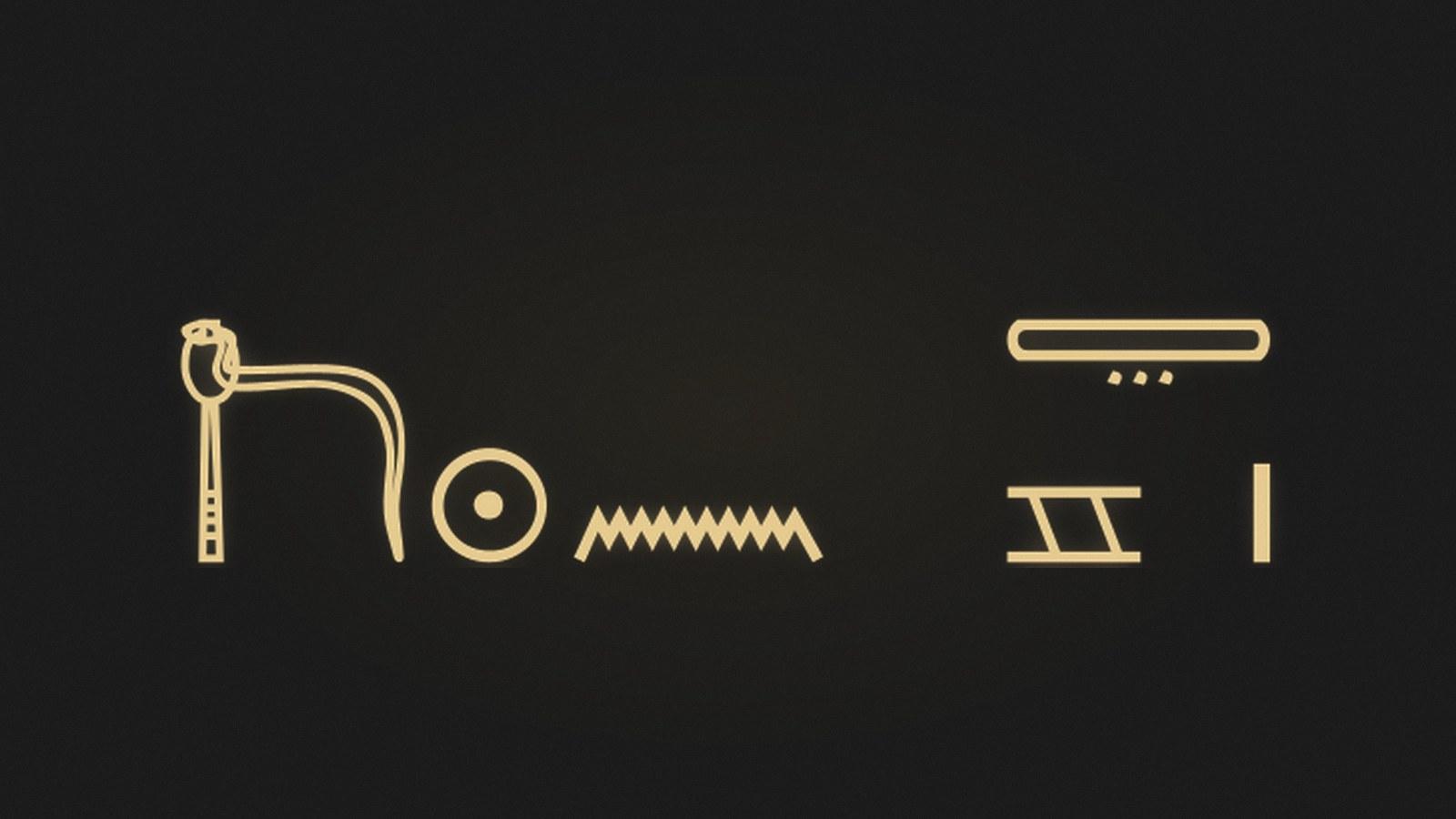
In a clause of time, Gardiner explains, the verb form sets the time: sḏm·f refers to the same time as the main clause, and the sḏm·n·f of the seventeenth lesson to an earlier one. Such a clause can follow the main clause or come before it, as here:

ḥḏ·n tꜣ is literally "the land had become bright", the sḏm·n·f of ḥḏ, "be bright", written with a mace. The main clause follows, iw·i ḥr·f, "I was upon him", with iw and a suffix pronoun. mi wn bik belongs to the second kind of clause, below.
The same pattern gives reasons. Gardiner says clauses of cause tend to use sḏm·n·f, "since the act assigned as cause is as a rule anterior to the action expressed in the main clause", though examples are uncommon. One comes from the story of Sinuhe:

Both halves are sḏm·n·f, and only the sense makes the second a reason. Allen quotes a sentence that opens with the twenty-ninth lesson's ꜥḥꜥ·n rdi·n·f n·(i) nn, "thereupon he gave me this", and goes on rḫ·n·f iḳr st-ꜥ·(i), "because he knew the excellence of my action". As he puts it, "the notion of causality comes from the context, not from the verb form itself".
Sometimes the clause describes an attendant circumstance, and English often uses a participle: iw ir·n·i tꜣš·i, ḫnt·i ityw·i, "I made my boundary, going further south than my fathers". Gardiner notes that the stative of the eighteenth lesson is very common in such clauses, as in ir·n·i hrw 3 wꜥ·kwi, "I spent three days alone". So is ḥr with the infinitive, from the nineteenth lesson: Allen quotes Sinuhe's sḏm·n·i ḫrw·f iw·f ḥr mdt, "I heard his voice when he was talking". In such clauses, Allen notes, a pronoun subject needs iw, while a noun subject stands alone. The clauses of purpose of the twenty-fifth lesson are virtual adverb clauses too.
Prepositions as conjunctions
The second kind works like English "since I came" or "after he went", Gardiner's own examples: a preposition from the tenth lesson stands before a clause, as a rule a sḏm·f. He lists, for time, ḫft, "when", ḏr, "since", m-ḫt and r-sꜣ, "after", r, "until", and tp-ꜥ, "before"; for cause, n and ḥr, "because". With sḏm·f the time is usually that of the main clause, as in mdw·k ḫft wšd·f tw, "thou shalt speak when he addresses thee". After ḏr and r-sꜣ it lies earlier. sḏm·n·f appears only after m-ḫt, r, mi and ḫft, always for an earlier time:

ḫr is translated "now"; Allen says this particle lets an adverb clause stand at the head of its sentence. Then come m-ḫt, "after", grg·n·i, "I had founded", written with a pick digging a pool, and pr, "house".
Before a sentence without a verb, Gardiner says, the usual expedient is the sḏm·f of wnn, "be", which is wn:

The falcon on its standard is the king's "I", so ḥm·i is "My Majesty", and m introduces the predicate, "a child". Allen quotes the same words: "since (the time) My Incarnation was a child". After mi, "like", the same wn gives "as though": the mi wn bik of the first example.
Clauses with ntt
The last variety puts the last lesson's ntt, "that", after the preposition. Gardiner says such a clause "always follows the main clause", and that these are all clauses of cause: ḥr-ntt, "because", "forasmuch as", n-ntt, "because", and ḏr-ntt, "since". Without ntt the clause is essentially verbal; with it, it takes various types of sentence, "verbal no less than non-verbal". Both grammars quote this one:

After ntt, Gardiner notes, the suffix ·f is preferred to the dependent pronoun. Allen gives the whole sentence: "The heart of steward Nu, justified, is happy, since he is one among these." He adds that a cause is more often given this way, and that such a clause cannot come first. Allen lets only clauses with particles such as ist, and a few special verb forms, come first, so he would analyse the opening clause of the first example differently.
The next lesson turns to the infinitive, the verb used as a noun, which can also follow these prepositions, as in m-ḫt with the infinitive, "after returning".