The last lesson ended with speech, which stories bring in with ḏd·in, "then said". This lesson looks at another way to report what someone said, saw or knew: a clause that does the job of a noun. Alan Gardiner defines a subordinate clause as part of a sentence "equivalent to a noun, adjective or adverb, while having a grammatical subject and predicate of its own". The twenty-first lesson met the adjective kind, and James Allen draws the parallel: "Just as a relative clause is a clause that functions like an adjective, a noun clause is one that functions like a noun."
Allen says a noun clause is most often the object of a verb or of a preposition. English usually marks it with "that", but can leave the word out, as in Gardiner's "I know he does". A clause with nothing to mark it except its meaning and its place in the sentence Gardiner calls a virtual subordinate clause, and such clauses, he says, are more common in Egyptian than in English.
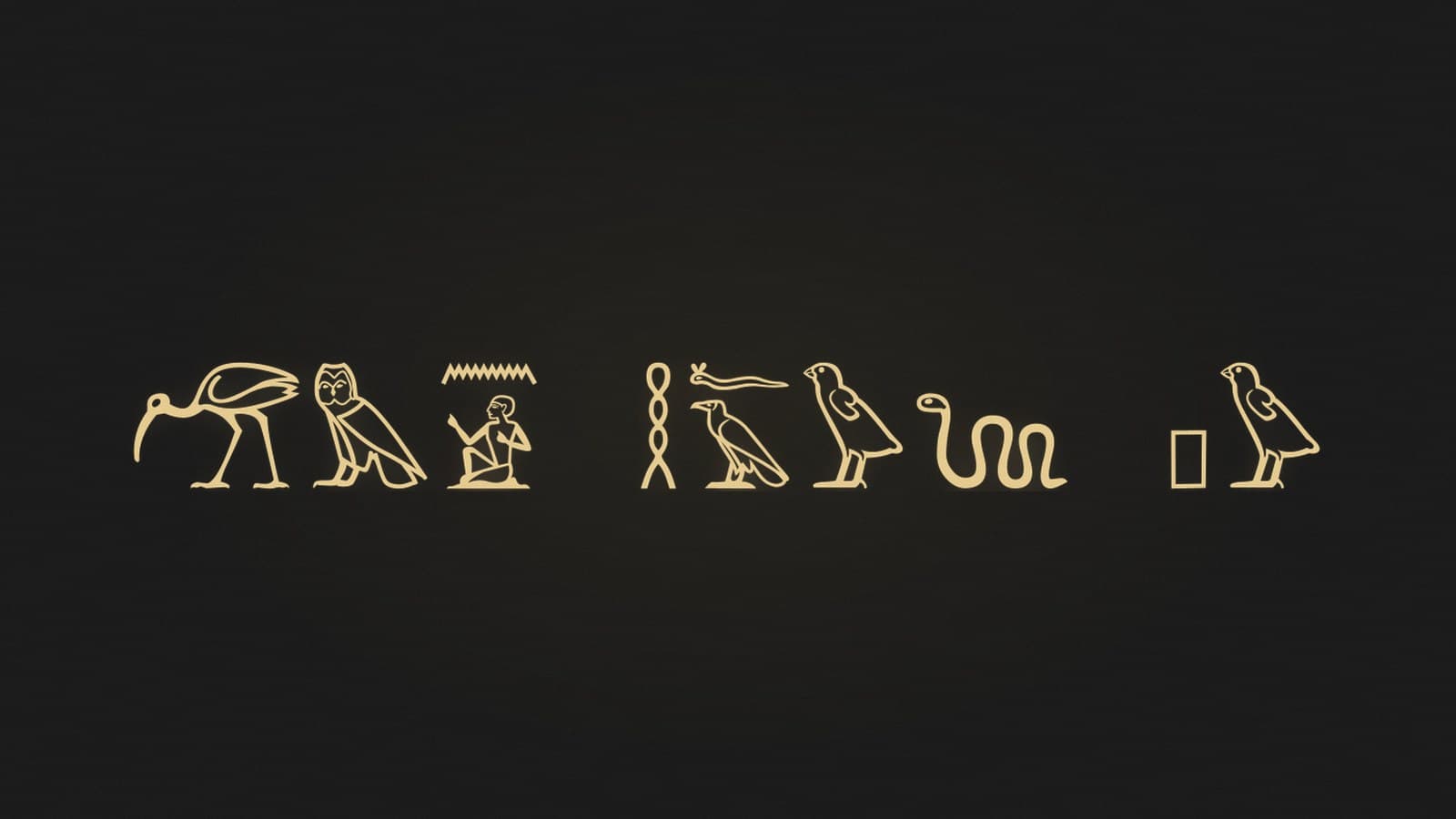
He said he would fight with me
Noun clauses, Gardiner says, "remain as a rule without introduction", and those with a verb are commoner than those without. One kind is already familiar: rdi with sḏm·f, "cause that he hear", from the twenty-fifth lesson, which Allen counts as the subjunctive in a noun clause. Other verbs take a sḏm·f as object in the same way, among them wḏ, "command", mr, "wish", rḫ, "know", and ḏd, "say". After them, Gardiner says, the sḏm·f "points to an act that may or will occur in the future". Both grammars quote this line from the story of Sinuhe:

ḏd·n·f, "he said", is the sḏm·n·f of the seventeenth lesson. ꜥḥꜣ·f, "he would fight", is written with two arms holding a shield and a battle-axe and a man striking with a stick; ḥnꜥ·i is "with me". Allen explains that such a clause could stand as a sentence of its own and is subordinate only because of its context, and that its action always comes after that of the main verb. For Gardiner this is the nearest Egyptian comes to indirect speech, which "hardly exists in Egyptian": behind it lie the words "I will fight with him".
I found it was a snake
A sentence without a verb, from the eighth lesson, needs some help to become an object. When its predicate is an adjective, Gardiner explains, the sḏm·f of the adjective-verb replaces the adjective itself:

The sickle with an eye is mꜣ, "see", followed by the n of sḏm·n·f. ḳnn·i, "I was brave", ends with a forearm holding a stick, its determinative, and the seated man for "I". When the predicate says where someone is, the clause uses the sḏm·f of wnn, "be", since iw, which the eighth lesson put before rꜥ m pt, cannot stand here: mr·n·f wn·i m Mꜣdw, "he desired me to be in Medamud". A sentence with pw needs no change. Both grammars quote this line from the Shipwrecked Sailor:

The ibis and the owl spell gm, "find", and the water line and the small seated man are ·n·i. ḥfꜣw pw, "it was a snake", is an ordinary sentence with pw. Allen points out that only the context, "the fact that it follows a verb", shows that it is a noun clause, and that the same is true of the English "I discovered it was a snake". A sentence with an independent pronoun from the twelfth lesson works the same way: rḫ·n·sn ink nb·sn, "they know I am their lord".
ntt and wnt, "that"
Gardiner says the particle ntt and the much rarer wnt are occasionally used after verbs of seeing and knowing. ntt is "properly the f. sing. of the relative adjective nty used as a neuter", the ntt of the twenty-first lesson, and he compares French qui, "who", and que, "that". Allen makes the same point with English, where "that" is both a relative pronoun and the mark of a noun clause. wnt, Gardiner suggests, is probably a feminine participle of wnn, "be".

rḫ·kwi is the stative that the eighteenth lesson translated "I know"; here Gardiner gives "I knew". After ntt, the water line over two loaves, comes a clause with a verb: ḥtp·f, "he would be pleased", and ḥr·s, "on account of it". Gardiner says ntt may introduce clauses with or without a verb, and both grammars quote one without, from the Book of the Dead: mꜣ·f ntt štꜣw pw ꜥꜣ, "he saw that it was a great secret". Allen notes a difference from the relative clauses of the twenty-first lesson, which normally say where something is: after ntt, "that", all three kinds of sentence without a verb can follow.
The grammars weigh ntt differently. Gardiner calls it occasional; Allen calls it "the usual mark of a noun clause with a nonverbal predicate", though he too says most noun clauses with the subjunctive are unmarked. One gap is a surprise: "Contrary to expectation", Gardiner writes, ntt "is not found after verbs of saying". The words spoken usually follow directly, as after the last lesson's ḏd·in.
As subject, and after a preposition
A noun clause can also be the subject, though Gardiner finds this "very much rarer". In one type an adjective is the predicate:

nfr·wy is "how good", with the exclamation ending -wy of the eighth lesson's "how beautiful is this woman!" The subject is the clause sḏm sꜣ n it·f: the ear and the owl for sḏm, the duck for sꜣ, "son", and it·f, "his father", with the viper the twelfth lesson found written but not read in "father". Allen's example is "It is very fitting that you should make your monument in Heliopolis."
Allen adds that a clause with ntt can follow a preposition. The commonest pairs are n ntt and ḥr ntt, "because", and ḏr ntt, "since". The twelfth lesson's ntk it n nmḥ, "you are the father of the orphan", follows ḥr ntt in a line he quotes from the Eloquent Peasant: "because you are a father to the orphan". Gardiner files these under adverb clauses, "the preposition being regarded as inside the subordinate clause", and Allen agrees that the pair does the work of an adverb.
The next lesson takes up those adverb clauses: "when", "while" and "because".