The last lesson met tm, the negative verb that takes whatever verb form a sentence needs, followed by the negatival complement. This one meets a verb form that grammars call sḏmt·f. Alan Gardiner describes it as "partly verbal and partly nominal", and its mark is "a formative t appended immediately to the verb-stem": sḏm, "hear", gives sḏmt·f. James Allen calls this t an ending rather than a suffix, because it is normally written as part of the stem, before any determinative. That sets it apart from the n of sḏm·n·f and the in, ḫr and kꜣ of the twenty-ninth lesson, which come after the determinative.
Gardiner gives the form three uses: after n, "not", chiefly meaning "he has (or had) not yet heard"; as a narrative tense, which he marks "rather doubtful"; and after prepositions, as in r sḏmt·f, "until he has heard". Allen describes only the first and the last, and this lesson keeps to those two.
Before and not yet
Allen calls the use after n the most common. Gardiner finds n sḏmt·f "particularly common as a virtual adverb clause" meaning "before he has (had)", literally "he has (had) not (yet)". Allen gives the same range: "before he heard", "before he has heard" or "before he had heard". Both grammars quote a speaker who says "I was one of those worms which the Unique Lord created" (Gardiner's translation), and goes on:

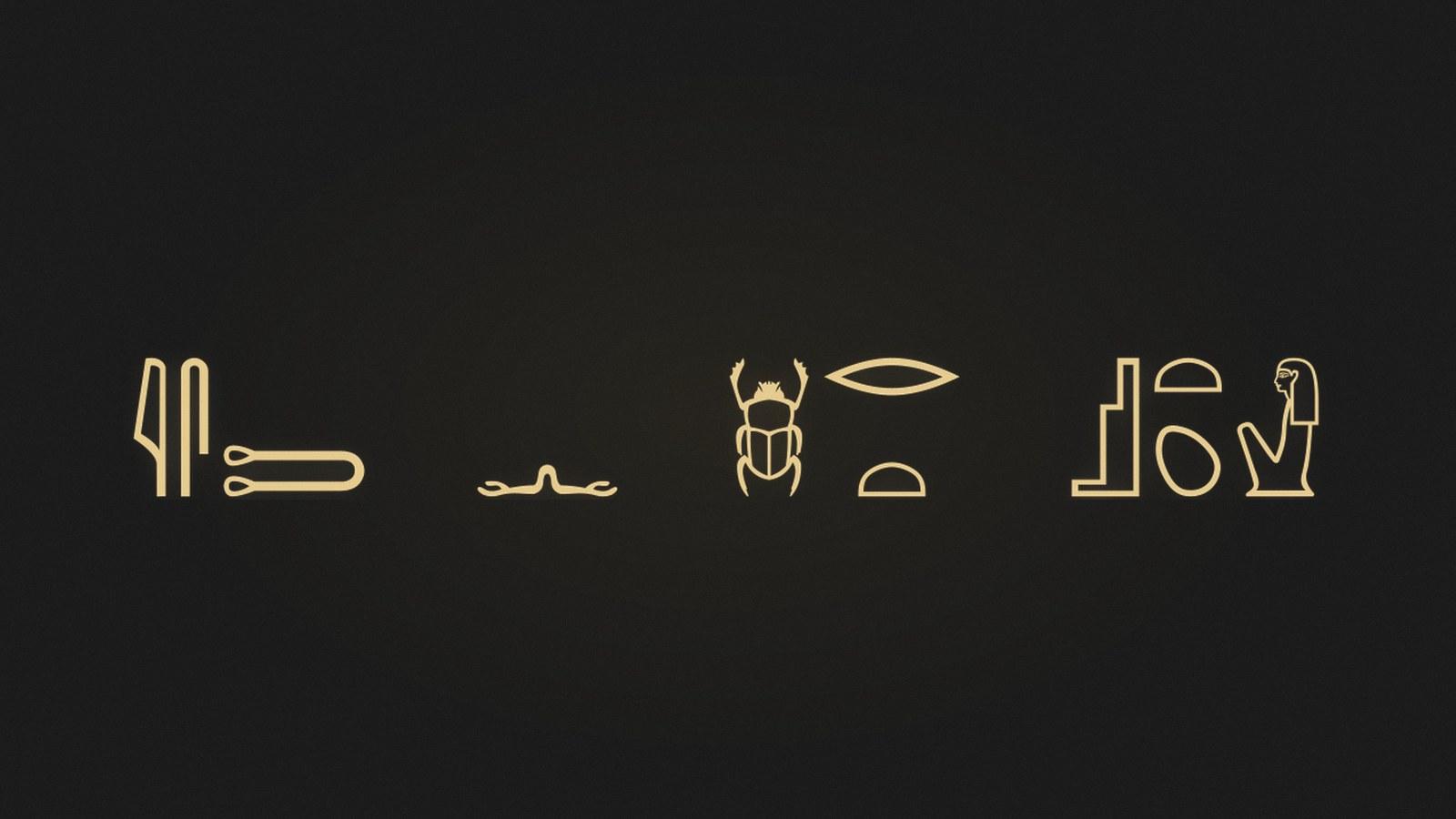
The scarab and the mouth spell ḫpr, "come into existence", and the loaf under the mouth is the t. Isis, ꜣst, ends with a seated woman. Allen notes that such clauses usually have no introductory word; this is one of the rare ones marked by isṯ. Gardiner warns that n sḏmt·f is not "essentially subordinate in meaning", because it also turns up after words that elsewhere introduce main clauses, such as isṯ and the iw of the twenty-ninth lesson:

mrt is mr, "be ill", written with a chisel and the owl, and the subject, irt·f, "his eye", follows the verb as usual. After a relative word, Allen says, the form is usually translated "not yet" with an English perfect, as in Gardiner's m ḥꜥw n ntt n ḫprt, "do not rejoice over what has not (yet) happened", where the context makes a subject unnecessary. The Shipwrecked Sailor leaves it out too: sr·sn ḏꜥ n iit, nšny n ḫprt·f, "they could foretell a storm before (it) came, and a tempest before it happened".
Not, cannot and not yet
The ninth lesson found that n before one common verb form mostly gives a past meaning, and the seventeenth lesson named it: n sḏm·f, "he did not hear". It also showed that n sḏm·n·f is often present, "he does not" or "cannot hear", and apparently never "he had not heard". n sḏmt·f supplies the third meaning, "he has not yet heard". Allen draws the line: n sḏm·n·f, his negated perfect, does not have the "before" or "not yet" meaning. For him the sḏmt·f "seems basically to express the action of the verb as completed", so n sḏmt·f is "he has not yet completed hearing". Gardiner traces it instead to a passive participle: "not (is) the having been heard of (i.e. by) him".
In verbs like sḏm and ḫpr, Gardiner says, "the formative t is simply added to the stem". In verbs with a weak last letter, such as iri, "make", the form "has the appearance of the infinitive": irt·i, "I had made". With a passive meaning it looks like a feminine passive participle, as in n msyt kꜣw, "when bulls had not yet been born".
One verb behaves differently. Gardiner files n wnt, "there is (was) not", here too, but finds no example meaning "before there was". Allen agrees: it denies that its subject exists, like the nn and nn wn of the ninth lesson, as in smr wꜥ n wnt snw·f, "a courtier without equal".
Until and since
The use after prepositions, Gardiner says, "at all events, is a genuine use" of the form. His certain examples come with only two prepositions: r, "until", and ḏr, "since", "from the moment that", which can also mean "before" or "until". r is the preposition of the tenth lesson, used there for going "to" a place. In Gardiner's first example the main verb looks ahead: "A torch shall be lighted for thee in the night":

In wbnt, "has arisen", the loaf for t stands before the sun, the determinative, just as Allen describes. šw, "sun", is the feather, the chick and the sun, and šnbt·k, "thy breast", ends with a piece of flesh and the basket for ·k.
Gardiner asks how this differs from a preposition followed by the sḏm·f of the twenty-fifth lesson or by sḏm·n·f. In every certain example, he finds, the action is "relatively past", earlier than that of the main verb. Allen translates r sḏmt·f "until he has/had heard" or "until he heard", at heart "up to (the point of) his completing hearing". His example comes from the Shipwrecked Sailor: "Look, you are to spend month upon month until you have completed four months in the interior of this island". "Until you have completed" is r kmt·k, and the last words are the tenth lesson's "within this isle". With ḏr, Allen says, the form normally means "since" in the sense of "because": "'Say my name,' says the ground, 'since you have stepped on me.'"
After r and ḏr, Allen adds, this form, not sḏm·n·f, is the normal one, and Gardiner thinks that may be why sḏm·n·f is comparatively rare there. Other prepositions are uncertain ground. Gardiner provisionally adds m, "when", m-ḫt, "after", ḫft, "when", and mi, "like", although his examples could all be infinitives, and Allen thinks they probably are. In his Additions and Corrections, though, Gardiner gives a clear example after m: m wnt ḫryt ḥnꜥ Tꜣ-wr, "when there was war with the nome of Abydos".
The negative verb of the last lesson has this form too. Gardiner quotes one example, from the Instruction of Ptahhotep: "Deal with him privately":

tmt·k is tm, the sledge and the owl, with the loaf for t over the basket for ·k, "thou". So when a verb carries a t straight after its stem, look at the word in front of it: after n it means "before" or "not yet", after r "until", and after ḏr "since".