The second lesson showed that an Egyptian adjective follows its noun and agrees with it, so that nfr, "good", becomes nfrt beside a feminine noun. English adjectives also change to compare things: "great", "greater", "greatest". Egyptian ones never do. In Alan Gardiner's words, "The Egyptian adjective has no special forms to indicate the degrees of comparison." James Allen spells out what that means: nfr can be "good", "better" or "best", and "in some cases, only the context will tell" which is meant. Often, though, Egyptian adds a short phrase that settles it.
More than: the preposition r
"More than" is the preposition r. The tenth lesson mentioned this use, with nfr r ḫt nbt, "better than everything", and the eleventh lesson quoted nfr st r ḫt nbt, "it is more beautiful than anything". Gardiner says r here means "more than", "literally perhaps 'relatively to'". Allen translates it "with respect to": it points to the thing the adjective is compared with, "almost always another noun or noun phrase". Gardiner's example:

ꜥšꜣ, "many", is the lizard with three strokes. It comes first because it is the predicate, as in the adjectival sentences of the eighth lesson, and Allen notes that the phrase with r comes after the subject. The subject here is st, which can mean "they" or "it": Gardiner translates this very line "they were more numerous than anything" in one place and "it was more plentiful than anything" in another. A noun subject takes the same place: wr ḥst·i m stp-sꜣ r smr wꜥty nb, "greater was my praise in the palace than (that of) any Unique Friend".
The brackets are Gardiner's, because, as he puts it, "Comparison, from our point of view, is much abbreviated in Egyptian": the speaker sets his praise against the courtier, not against the courtier's praise. The same happens with mi, "like", in the story of Sinuhe: "the fear of him is throughout the lands like (that of) Sakhmet in a year of pestilence".
The phrase with r works with the other uses of adjectives too. Allen's examples are an epithet, nṯr mnḫ r nṯr nb, "a god more beneficent than any god", and an adjective standing by itself, nfrt r ḫt nbt, "something better than anything". A pronoun after r is a suffix, as after the other prepositions of the tenth lesson, so Gardiner's Additions have sr nb ꜥꜣ r·i, "any official greater than me". Gardiner shows the same r after verbs: sꜥꜣ·n·i sw r imt-ḥꜣt, "I made it greater than it was formerly", literally "I made it great more than what-was-in-front". Before an infinitive it gives the English "too ... to": ꜥšꜣ r smnt, "too many to record", or in Gardiner's literal version "many as compared with recording".
Greatest of the great
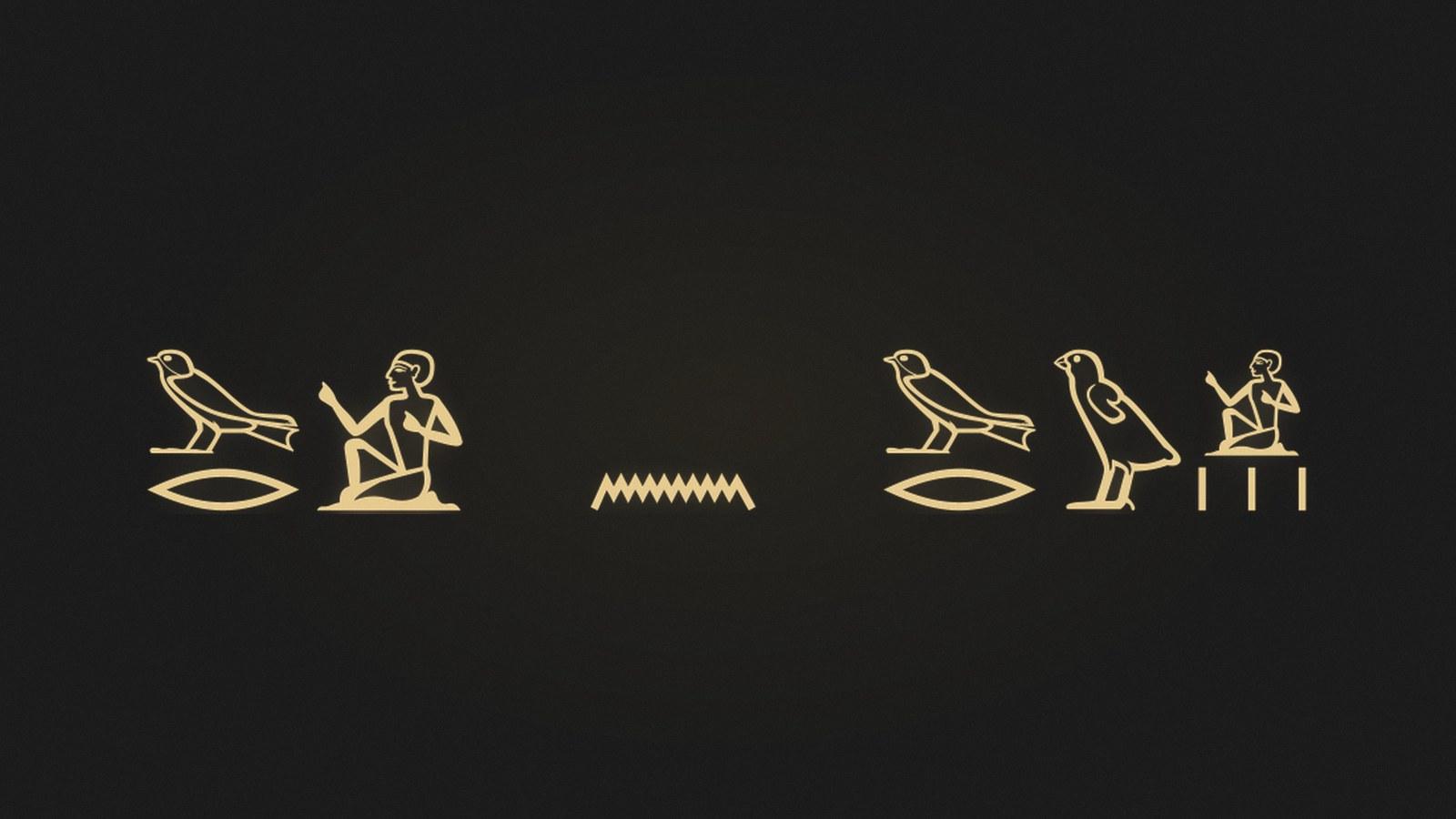
"Most" can be said in several ways. Gardiner's first is a genitive, and Allen says this is the commonest, with either of the two ways of saying "of" from the fourth lesson. He adds that Egyptian normally uses the superlative with adjectives "that stand by themselves and do not modify a noun":

Literally it is "the great one of the great ones". Each wr, "great", is the swallow over the mouth, followed by a seated man: as the second lesson showed, an adjective used as a noun often takes a determinative. Allen also gives the direct genitive, wr wrw. Gardiner's next example puts it in a sentence with ink, "I", from the twelfth lesson: ink wr wrw m tꜣ r ḏr·f, "I was greatest of the great in the entire land".
Instead of a genitive, the adjective can be followed by imy, "who is in", the nisbe of m from the sixth lesson:

Gardiner's literal rendering is "being in" the nobles. Allen, who glosses imy as "among", gives the same phrase as "greatest of the dignitaries" or "the greatest dignitary". The goat with a collar is the sign Gardiner's sign list gives for sꜥḥ, "rank" or "dignity", and words related to it.
Gardiner adds that "the repetition of a suffix may help to indicate superlative meaning":

Word for word it is "his son his eldest", with the viper for ·f after both words. smsw, "eldest", is written with an old man bent over a stick. Last, Gardiner names wꜥ, "one" or "alone":

His translation is "alone excellent, i.e. uniquely excellent". The harpoon over the arm spells wꜥ, and iḳr, "excellent", ends with an upright papyrus roll.
Very
For "very", Gardiner says, wrt, literally "greatly", "is of common occurrence", as in štꜣ wrt, "very difficult". Allen quotes the whole sentence from the same source, štꜣ wrt wꜣt, "The path is very inaccessible", and notes that wrt goes between the adjectival predicate and its subject. It can follow an epithet too, as in Gardiner's ink sš iḳr wrt, "I am a very excellent scribe". Gardiner adds that the common phrase r ḫt nbt, "more than anything", "conveys much the same sense", and the two can go together: ist ꜥšꜣ wrt r ḫt nbt, "and lo, (they were) much more numerous than anything".
Adverbs work the same way. Allen notes that they too "have no special form" for comparison, and that the sense is usually clear from the context; where it is not, r does the job, as in wr r ḫt nbt, "more greatly than anything". Gardiner gives one more way of saying "very" with an adverb: repeat it, which the scribe shows with signs read sp sn, "twice", as in mꜣꜥ mꜣꜥ, "very truly", and ꜥšꜣ ꜥšꜣ, "very often".
So the adjective itself never changes: r says "more than", a genitive or imy says "most", and wrt says "very". The next lesson turns to putting a word first, with anticipatory emphasis and ir, "as for".