The thirteenth lesson set out the normal order of an Egyptian sentence with a verb, and noted that other orders are uncommon: Alan Gardiner finds them more often than not made for emphasis, and James Allen notes that a long noun subject is sometimes put in front of the verb and repeated after it by a pronoun. This lesson looks at that device. Gardiner calls it anticipatory emphasis: a noun, adverb or adverbial phrase "removed from its regular place and put outside and in front of the sentence". The word in front becomes "the pivot upon which the whole sentence turns".
Except with a mere adverbial expression, Gardiner says, a resumptive pronoun must stand inside the sentence in place of the word moved out. Modern languages do the same, as in his English parallel, "every man that dies ill, the ill is upon his own head". Allen calls the device topicalization, "preposing an element of the clause in order to focus attention on it", and notes that English allows it "in the same way that Egyptian does".
In front of a sentence without a verb
Gardiner's first examples have no verb. In this one, from the story of the Shipwrecked Sailor, the subject is put at the head:

ḫbswt·f, "his beard", ends with a loaf over a lock of hair, the determinative for hair. A sentence of the eighth lesson's kind follows, adjective first: wr sy, "it was great", where sy, the dependent pronoun "she, it" of the eleventh lesson, written with a single folded cloth, takes the place of the beard. r is "than", as in the tenth lesson and the last one, and the cubit is a whip over a forearm, then two strokes for 2. Gardiner warns that the effect is "sometimes different from what might be expected": here the stress falls on what is said about the beard, not on the beard itself. A noun can even be lifted out of a genitive: "each one of them, his heart was stouter, his arm stronger, than his fellow('s)".
In front of a sentence with a verb
Allen adds that a shorter subject can be put first too, "for stylistic reasons, or to focus attention on it", as in "Old age has descended, feebleness has overtaken me". The object can also come first:

snty·k, "thy sisters", is the arrowhead, a loaf and two seated women, with the basket for ·k. di·n·i, "I have placed", is the sḏm·n·f of the seventeenth lesson, and sn, "them", is the dependent pronoun that takes the place of the sisters. m sꜣ, "as a protection", is written with a hobble for cattle, which Gardiner's sign list reads sꜣ, and ḥꜣ·k, "behind thee", ends with a papyrus clump and the basket. Allen's example is "All the good produce of Retjenu, I have plundered it completely", with st, "it", repeating the object.
An adverbial phrase can come first with no pronoun at all: m-ḫt nn wḏꜣ ḥm·f r šnꜥ n wdn, "after this His Majesty proceeded to the workshop of offerings". Allen notes one limit: the subjunctive, his name for the sḏm·f of wishes in the twenty-fifth lesson, is rarely used with a preposed or topicalized subject.
ir, "as for"
Gardiner explains that the preposition r may mean "as to" or "concerning", and that at the beginning of a sentence it shows its original full form, ir. For Allen the basic meaning of r is "with respect to", and "as for" is its use at the start of a sentence. Placed before the word to be stressed, ir makes an adverbial phrase in anticipatory emphasis. Both grammars quote this example:

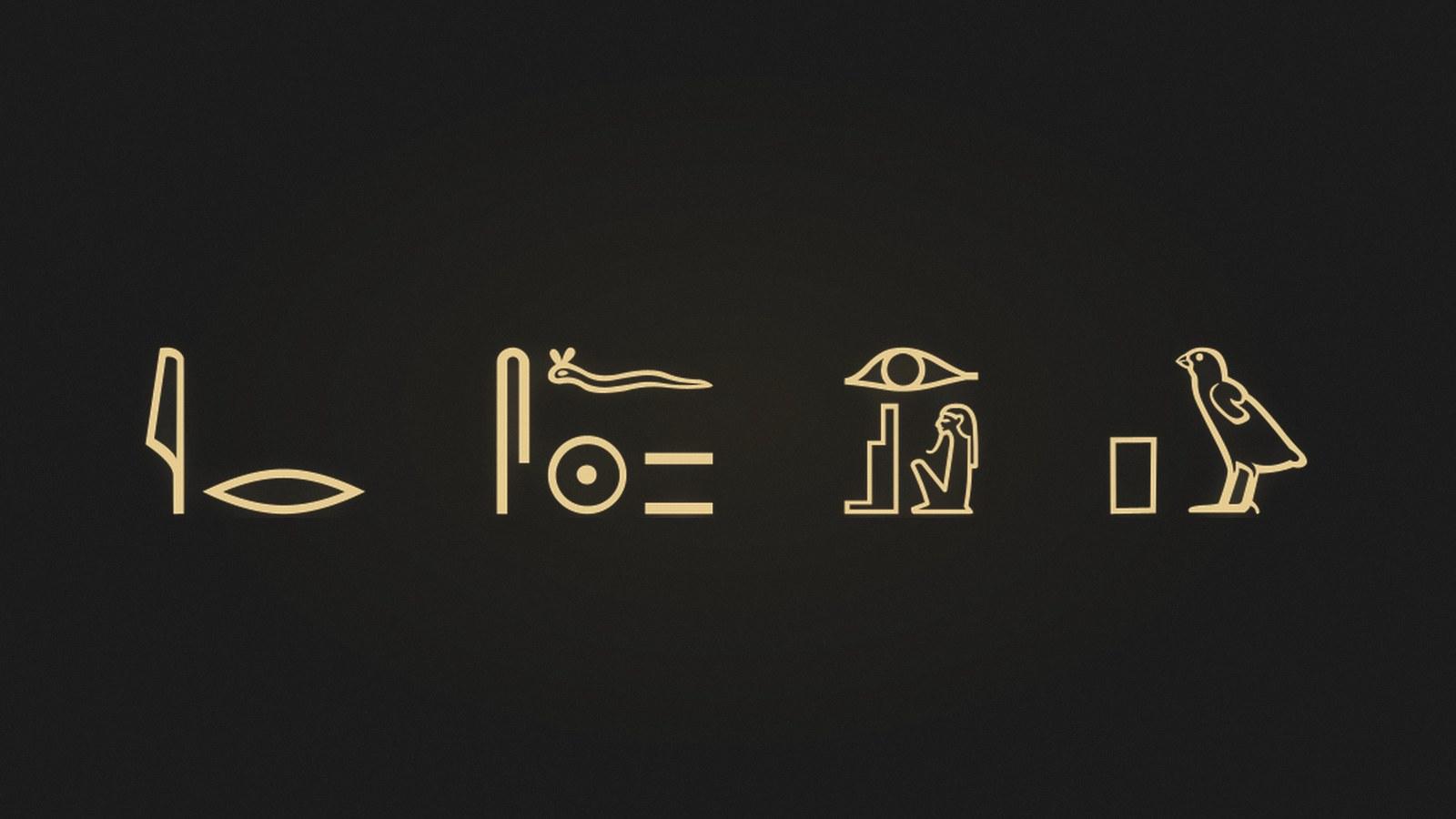
sf, "yesterday", is the folded cloth and the viper, with the sun and two short strokes. Osiris, Wsir, is the eye above the seat, with a seated god, and pw, "it", is the pw of the eighth lesson. ir often brings in a long subject:

ḫm, "not know", ends with the arms of negation, which Gardiner's sign list gives as its determinative, and r pn is "this spell". The suffix ·f takes up the whole long phrase, and n ꜥḳ·n·f is the n sḏm·n·f of the seventeenth lesson, which says that someone does not or cannot do something. Gardiner sees "a frequent motive for the use of ir" in "the desire to lighten the sentence by placing outside it some lengthy and cumbrous member". ir can pick out an object too: ir ntt nbt m sš ḥr pꜣ šfdw sḏm st, "as to all which is in writing on the papyrus-roll, hear it", with st after the imperative of the twentieth lesson. Allen's example is "Moreover, as for everything His Incarnation commanded I do for him, I did it."
ir, "if"
A variety of the same construction, Gardiner says, is ir meaning "if" before the sḏm·f. The verb and its adjuncts serve as a noun clause, so the strict translation is "as to he-hears", and the if-clause comes before the then-clause: ir sḏm·k nn ḏd·n·i n·k, wnn sḫr·k nb r ḥꜣt, "if thou hearkenest to this that I have said to thee, every plan of thine will go forward". Allen agrees that the "if" clause is normally introduced by ir, "actually the full form of the preposition r", and that it always comes first. He adds that ir can also be translated "when" or "as", and that his subjunctive, with its contingent meaning, is "a natural form" for such sentences. Adjective verbs take the sḏm·f too:

iḳr·k, "thou art well-to-do", ends with a papyrus roll, and grg·k, "thou shalt found", has the pick digging a pool. With an adverbial predicate the verb "to be" is used, as wnn·f: ir wnn·k ḥnꜥ rmṯ, "if thou art together with people", is the conditional form of iw·k ḥnꜥ rmṯ, with the iw of the eighth lesson. Such a clause is negated with tm·f, the negative verb of the thirty-third lesson.
Near the end of the chapter Gardiner adds a relative of ir: the enclitic rf of the twenty-seventh lesson, which comes from r with the suffix ·f, "may do for whole sentences what ir does for parts of sentences". The next lesson meets the sḏmty·fy, the form for "one who will hear".