The twenty-fifth lesson met Alan Gardiner's two kinds of sḏm·f: a doubled form such as mꜣꜣ·f or dd·f, which he calls the imperfective sḏm·f, and a plain one such as mꜣ·f or di·f, his perfective, which carried the wishes of that lesson. This lesson takes up the doubled form. Gardiner sees it "often conveying notions of repetition or continuity", but admits that for some uses of both forms "the connection with the perfective or imperfective ground-ideas remains obscure".
Only verbs that can double a letter, the classes of the twenty-second lesson, show the form. Gardiner lists wnn·k from "be", irr·k from "make", ḫdd, "flows", and inn·t(w) from "bring", and notes that "come" has no doubled form at all.
Again and again
Gardiner's reasoning starts from the imperfective participles of the twenty-third lesson. Since they "regularly imply the notions of repetition or continuity", he argues, the same notions "ought to be perceptible" in the doubled sḏm·f. In main clauses about the present he finds it "in statements of custom or aphoristic truths", like this line of Ptahhotep:

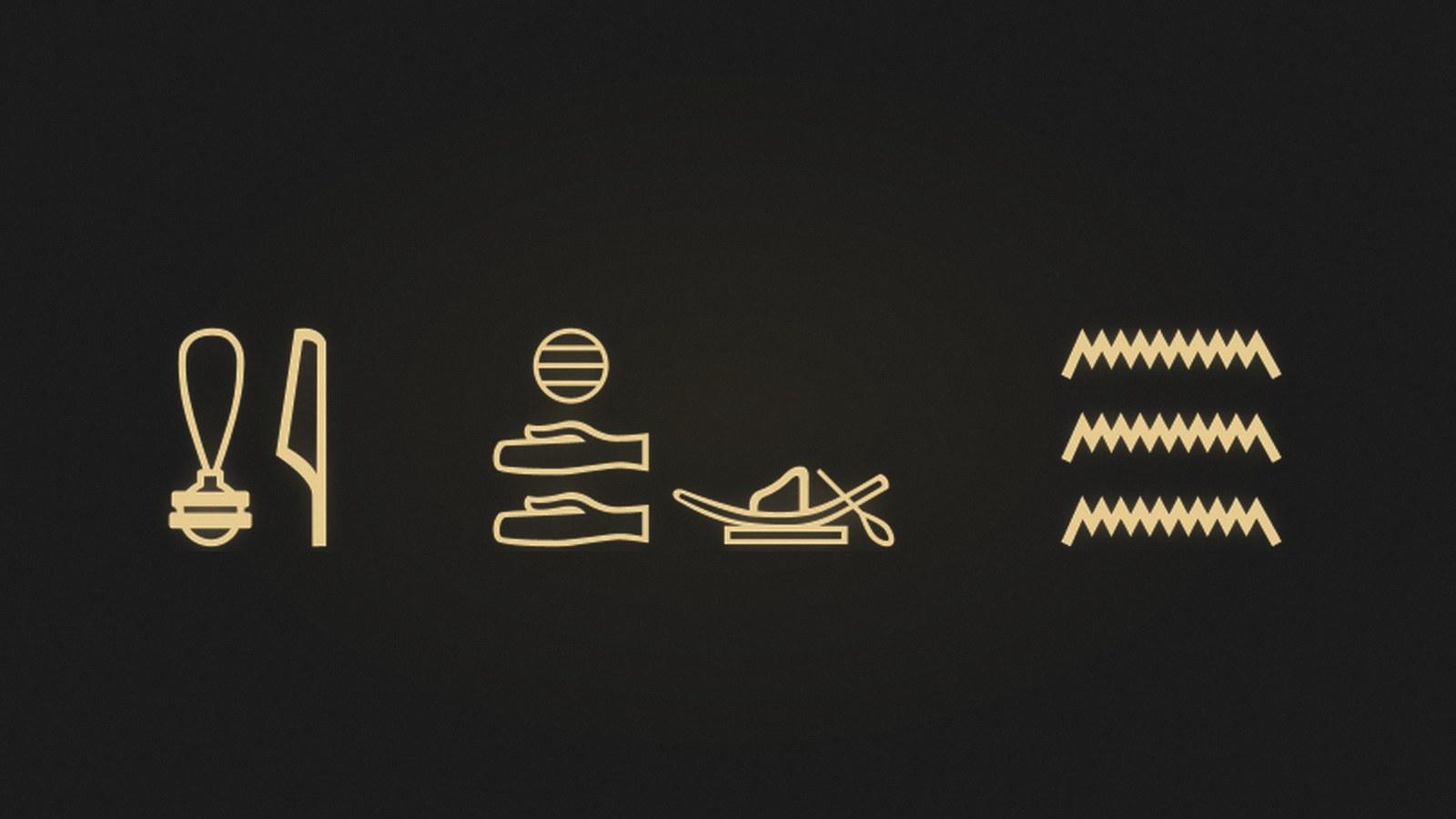
inn·tw, from ini, "bring", has two water lines for the doubled n, then the tw, "one", of the twenty-eighth lesson. Another manuscript, Gardiner notes, has iw in·tw instead, "using the iw sḏm·f form which regularly has reference to customary acts". James Allen quotes a version of the same line with iw in·tw: "Close friends are brought when there is a disaster".
The form can also describe past custom, though Gardiner finds examples "not common": "I used to sail down with its tribute to the king every year". His other example is a single clause:

sny-mnt is a compound noun, in Allen's words literally "the surpassing of suffering". Gardiner admits that wnn might be read as a sḏm·n·f, but notes several examples nearby of the negation n sḏm·n·f, which, as we will see, goes with the doubled form. Allen gives the same words as "The land was continually in distress", an ongoing state.
The doubled form looks ahead in "contracts, rules and the like", for "some customary or prescribed act destined to occur in the future": dd·f kt hrw n wpt-rnpt, "he shall give another on the day of the New Year". Its dd is written with the two loaves of the twenty-second lesson, and wpt-rnpt is the New Year's Day of the sixteenth. The twenty-fifth lesson's wish irr ḥm·k m mrr·f is another use for the future.
Whenever, and when he sees
In subordinate clauses, Gardiner says, the doubled form has "relatively present meaning": its action happens at the time of the main verb, like the plain sḏm·f in the clauses of time of the thirty-first lesson. It differs from the plain form "mainly through its inherent notion of repetition or continuity", so in a clause of time it can mean "whenever": ḫdd·k, dd·tw n·k sꜣ-tꜣ is "when (or whenever) you sail northwards, reverence is paid to you". After a preposition, too, Gardiner finds the choice of the doubled form in certain cases "undoubtedly due to the notion of repetition or continuity", as after mi, "as when", in similes. Of wine found lying in its vats, one text says:

That is, Gardiner explains, "their wine was as abundant as ever-flowing water". ḫdd, "flows", from ḫdi, "fare downstream", has two hands for its doubled d and a boat, and mw, "water", is three water lines. Likewise m dd Wsir, "by the gift of Osiris", appears "only where the gift is repeated or generalized", while plain m di suggests a single gift. After "see" and "know" the doubled form is "more apt to be found", "because what is seen or known is an action in progress or a continuously exerted quality": mꜣ·n ḥm·f ḳnn·i, "His Majesty saw how valiant I was".
Not every case fits. With mꜣꜣ, "see", Gardiner admits, the doubling "occurs irrespective of any notion of repetition". He calls this line of Sinuhe "a characterization":

Yet the same mꜣꜣ·f serves for one moment in "when he saw the asses of this peasant". Gardiner suggests that verbs of this class, among them wnn, "be", and mꜣꜣ, "similarly bear an implication of continuity", then stops: "We are here, however, in a hypothetical region where further speculation appears barely profitable."
The doubled form "hardly ever follows the negative words". Its negative is the n sḏm·n·f of the seventeenth lesson, which denies an action over a stretch of time; for Gardiner that is "important, if indirect, testimony" to the continuity in the doubled form.
Allen's perfective and imperfective
Allen uses the same two names for a different division, and warns in a footnote that his forms are not Gardiner's. His imperfective expresses "action that is in some way repeated, ongoing, or incomplete", an aspect rather than a tense. It doubles only in verbs like mꜣꜣ, and he quotes mꜣꜣ·f, "he sees", from the same line of Sinuhe. Verbs with a weak last letter keep the plain stem, and so does "give", with di·f. His table of forms gives in·tw, from his Ptahhotep line, as the imperfective of ini. In main clauses it states general truths, usually after iw. Its most frequent use, though, is in adverb clauses, where "it always expresses concomitant action", something going on at the same time: "I heard his voice as he was speaking", from another copy of the Sinuhe line that the thirty-first lesson quoted with ḥr and the infinitive. Like Gardiner, Allen takes the negated perfect as its normal negative.
Allen's perfective "simply expresses action", nearly always past, and its most frequent use, "just about the only use of this form in most texts", is the past negation n sḏm·f, as in Sinuhe's "I did not plan to arrive at that capital". In a summary table in his Lesson 26, his imperfective sḏm·f answers to Gardiner's perfective or imperfective, while Gardiner's imperfective answers to Allen's imperfective relative form used as a noun, the endingless form of the thirty-ninth lesson. Gardiner's last section on the doubled form answers a rival theory, and the next lesson, on the emphatic sentence, takes that up.