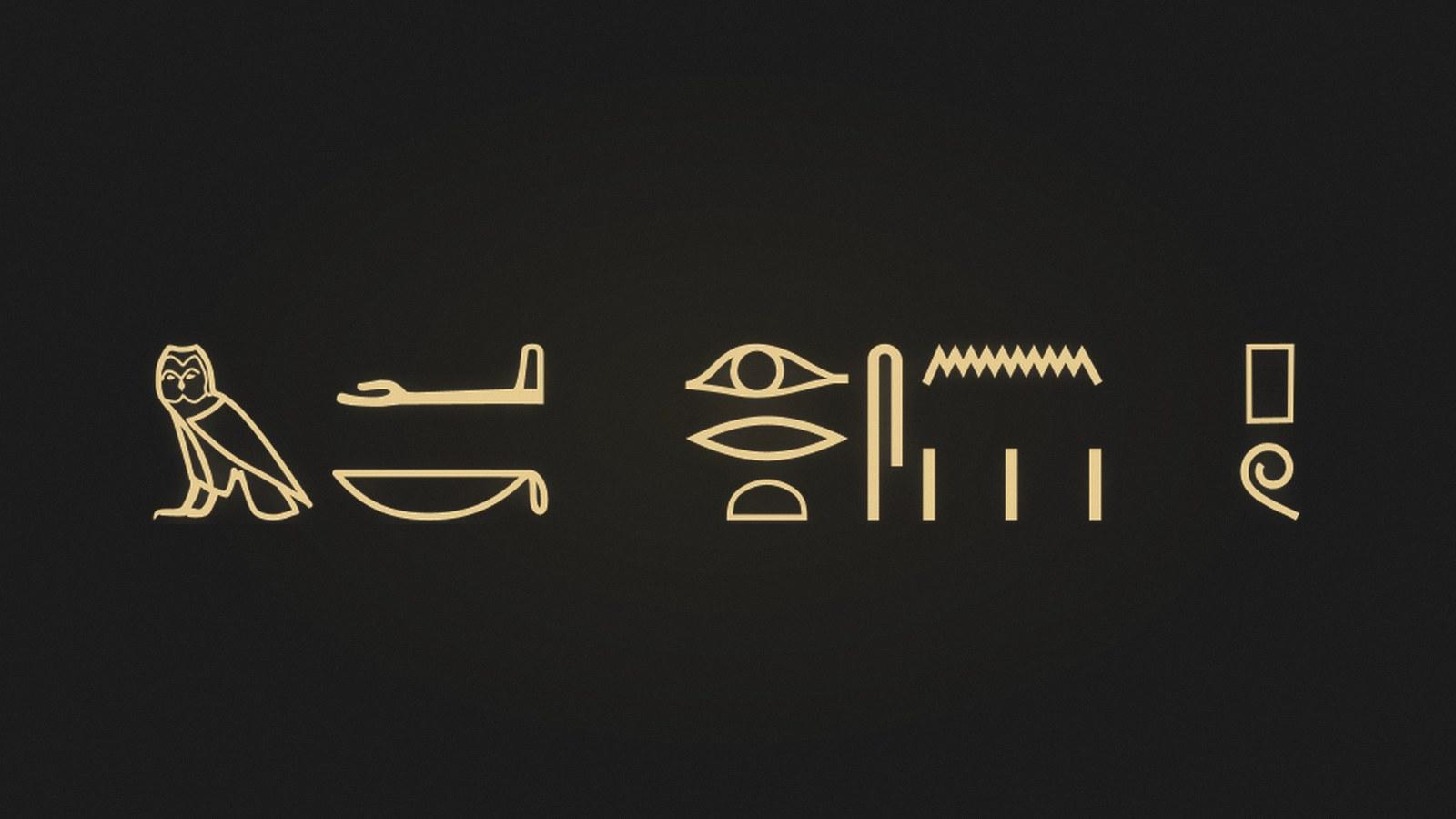
The twenty-third lesson showed that a participle can stand alone as a noun, and that English then usually needs "one who" or "that which", as in irrt, "what is done". The twenty-fourth did the same for a relative form: rdit·n·f n·i nbt, "all that he gave to me". This lesson looks at what such nouns do in a sentence. Alan Gardiner gives them a chapter of "special uses", and James Allen notes that a participle used as a noun has the same functions as any other noun.
Gardiner starts with what he calls the absolute use. A noun or an infinitive can stand alone "with the self-sufficiency of an independent sentence" in headings and titles, as the thirty-second lesson found, and so can these forms. ḏdt·n n·i bꜣ·i, "what my soul said to me", heads a speech: "The words spoken follow", Gardiner notes. rdit·n·f n·sn ḥr·s, "what he gave to them for it", is followed, he says, by "a statement of the things given". Allen finds the same use in titles, such as a Coffin Texts spell called "How a man does what he wants in the necropolis".
That is what they do
Why use a participle at all? Gardiner's answer, which the last lesson met behind the participial statement, is that a participle describes somebody or something, so "their use is apt to attract the listener's interest to that somebody or something": to what was said, not to the saying. The same holds with pw, the "it" of the eighth lesson, in a line from the Eloquent Peasant:

mk is "behold". irrt·sn is built like the mrrt of the twenty-fourth lesson, an imperfective relative form, here of iri, "do": the extra mouth writes the doubled r, the loaf is the feminine t of "that which", and ·sn, "they", is its own subject.
The same principle, Gardiner says, lies behind a way of telling a story "much employed in the Middle Kingdom stories". The twenty-ninth lesson listed prt pw ir·n·f among the ways to say "he went forth", and the thirty-second read it as "it is a going forth which he made". Here, Gardiner explains, "it is the action itself which is the centre of interest", so the action is an infinitive, followed by pw and the relative form ir(w)·n·f. Allen calls that form the perfect relative and glosses ir·n·f as "what he did". Gardiner's example is again from the Eloquent Peasant:

Word for word it is "it was going up higher which he did", and Allen's rendering of the pattern is "what he did was to hear". Gardiner finds it almost only with verbs of motion. Its rare passive puts iry, "what was done", in place of ir·n·f, and both grammars quote the same line of Sinuhe: iwt pw iry r bꜣk im, "then they came for this humble servant" in Gardiner's translation, "What was done was to come for yours truly" in Allen's.
Like what was found
As nouns, these forms can follow a preposition. Gardiner shows them after mi, "like", because Egyptian tends "to focus comparison upon some specific thing, rather than upon an action". So "as is done for a foremost Companion" is mi irrt n smr tpy, literally "like what is done", and "as he had foretold beforehand" is mi srt·n·f ḫnt, literally "like what he had foretold". A third example closes a text:

Literally it is "like what was found in writing", from gmi, "find", written with the ibis. Allen quotes the same words from the end of the Shipwrecked Sailor, where a closing note says the text runs from its beginning to its end, "like that found in writing".
Such a noun can also be the object of a verb like "know". Gardiner puts these where "Latin or Greek would show an indirect question". Sinuhe says:

Literally "I do not know him who brought me": in, written with a pot on legs, is a participle of ini, "bring", and wi, "me", the dependent pronoun of the eleventh lesson, is its object. Allen's example has the same shape: "We don't know what is happening throughout the land".
There is none who
To say "there is none who", Gardiner says, Egyptian uses the nn wn, "there is not", of the ninth lesson, with a participle or relative form as the thing that does not exist. Sinuhe again:

rwi, "one who can check", is the participle, and ꜥḥꜣw·f, "his arrow", is its object, with an arrow sign over the viper of ·f. A relative form works the same way: nn wn ḫmt·n·f r-sy, "there is nothing at all which he does not know". Gardiner warns beginners that these sentences do not deny the action. "What they negate is the existence of a person or thing described by the help of a participle or a relative form." To deny the action itself, both grammars agree, Egyptian uses tm, as in the thirty-third lesson.
With and without an ending
Allen draws a line that Gardiner does not. A relative form with an ending, like irrt·sn, still refers to an antecedent left unsaid, such as "thing", so for Allen it remains an adjective. His nominal use is a relative form with no ending at all, normally translated "that" or "how", which turns a whole clause into a noun: in mi mrr bꜣk im, "as your humble servant wishes", mrr has no ending. His spell title shows both kinds: irr s mrrt·f m ẖrt-nṯr, where endingless irr is "how (a man) does" and mrrt·f is "what he wants", with the t. Gardiner notes only that his examples after mi "overlap" with the use of a sḏm·f or sḏm·n·f form there; Allen counts such forms as relative forms too: unless there is good evidence to the contrary, he says, a sḏm·f or sḏm·n·f at the start of such a clause is most likely a relative form. These endingless forms have another use, which a later lesson takes up.