Near its end, the twelfth lesson left a pointer. Alan Gardiner, it noted, says the independent pronouns can be followed by a form of the verb, to say who it was that did something, and that pattern had to wait until verbs had been taught. The twenty-third lesson then met the participles, adjectives made from verbs that can also stand as nouns, "one who hears". The two meet in what Gardiner and James Allen both call the participial statement, the Egyptian way to say "it is I who did it".
Gardiner describes it as a sentence whose predicate is a participle, built on "the model of the sentence with nominal predicate": the subject comes first, and it "is either an independent pronoun or a noun introduced by the particle in". Allen sets out the same pattern in two parts. The first, A, is an independent pronoun or in with a noun; the second, B, is an active participle. Gardiner compares English "it is he who hears" and French c'est lui qui entend. Both grammars quote this line of Ptahhotep:

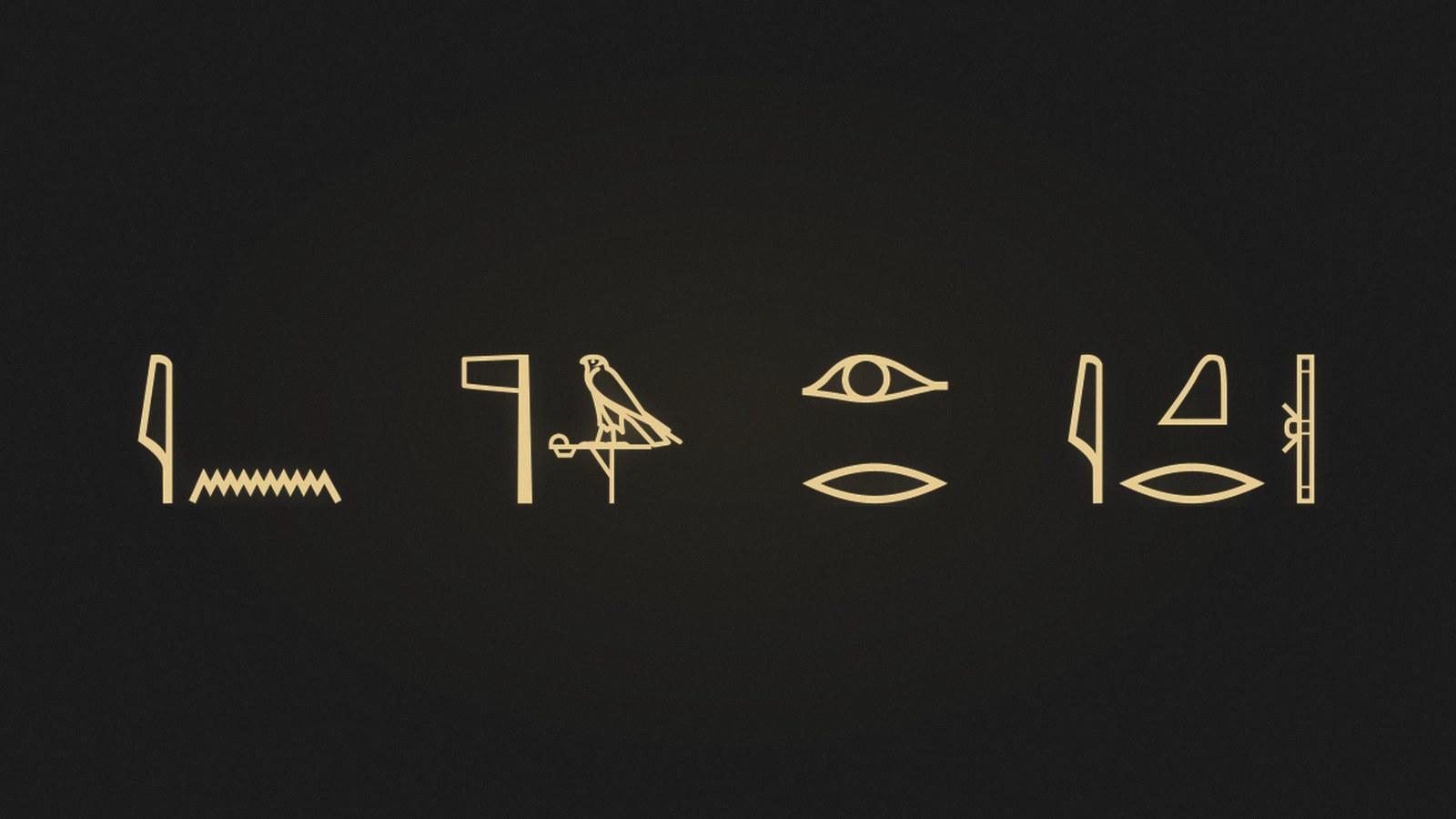
Following Gardiner's literal renderings, it is "indeed, god is the one who makes prosperity". nṯr, "god", ends with a falcon on a standard, which Gardiner's sign list says regularly marks gods in hieratic. irr is the imperfective participle of iri, "make", with the doubled r of the twenty-third lesson. Allen translates "The god is the one who makes success" or "It is the god who makes success".
The in is the small word that turns a statement into a question in the twenty-sixth lesson, one of the particles of the twenty-seventh. Gardiner glosses it "indeed": it lays "a stress of one kind or another on sentences or parts of sentences". He calls it "clearly identical" with the in, "by", that names the doer, as in the twenty-third lesson's "by his brother Seth". It is also part of the independent pronouns, whose first person the twelfth lesson saw built on in, and that, Gardiner says, is why in with a noun and an independent pronoun can do the same jobs.
Past and present
Gardiner's rule is that the perfective participle gives past time and the imperfective present time. One of his past examples concerns an elephant:

šꜥd, "cut off", ends with a knife and an arm holding a stick, and ḏrt, "hand", here the elephant's trunk, is a hand over the loaf and a stroke. With a noun, in comes first, as in this line from the Story of Sinuhe:

Gardiner's literal version is "indeed, His Majesty was the-one-who-caused". Those hyphens matter, because the participle never changes. It is "invariable in number and gender", he says, and must be read "the-one-who-hears (heard)", not "he (she)-who-hears (heard)". Allen agrees that it is always active and "always masculine singular, regardless of the gender or number" of A. So in Gardiner's "The liver has four vessels; it is they which give it water", ntsn dd n·s mw has the plural "they" but the singular dd, "the one who gives".
Both grammars allow the imperfective for something done habitually in the past, and both quote the same words from the Eloquent Peasant:

Allen offers "He is the one who used to give it to him" or "It was he who used to give it to him". dd, the imperfective of rdi, "give", is written with two arms holding loaves.
Who is the one?
Allen says the A part "is always emphasized", which English shows with "A is the one" or "It is A". Gardiner is more careful. Some emphasis rests on the subject, he says, "though this emphasis is not always calculated to make the grammatical subject into the logical predicate", and some examples must be rendered simply "X does" or "X did", "in having hardly any force at all". He traces the pattern to the participle itself, which draws the listener's attention to the doer and leaves the action secondary: "Herein too lies the secret of English 'it is he who does this' with the meaning of 'he does this'".
With an independent pronoun, Allen warns, the sentence looks just like the twelfth lesson's ink it·k. ink ir pt can be "I am the one who made the sky", answering "Who is the one who made the sky?", or "I am the one who made the sky", answering "Who are you?". It is the difference the twelfth lesson drew between ntf Rꜥ and Rꜥ pw. One clue, Allen says, is that a later pronoun agrees with A only in the participial statement: ink ir nn n it·i, "I am the one who made this for my father", but ink ḫsf ꜥwꜣ m ꜣt·f, "I am one who bars robbery by his wrath".
The twenty-sixth lesson's in m ḏd sw, "who says it?", is the same pattern with the question word in place of the noun, which is why Allen renders it "who is it who...?".
The future
The participle with a future meaning, Gardiner's sḏmty·fy, is "very rarely used" here, and Allen calls this "extremely rare". Instead the subject is followed by a sḏm·f, the form of the twenty-fifth lesson: ntf sḏm·f, or in with a noun and sḏm·f, which Gardiner says "has always future sense". His example follows "As to everyone who shall lift up his hand to this image":

Here, Gardiner says, in "merely marks the presence of this stereotyped future construction", so the English is plain; "it is X who will" fits only when the noun carries the weight. The verb now has its own suffix, and Allen notes that it always agrees with A. Set Gardiner's in ḥm·f rdi ir·t(w)·f beside his future ink rdi·i ir·tw·f n·k, "I will cause it to be made for thee": rdi·i carries ·i, "I", to match ink.
Allen also shows the whole statement denied with the n and is of the ninth lesson around its first word: n ink is prr r ꜣḫt, "I am not the one who goes forth to the Akhet". The "not", he stresses, belongs to the whole sentence, not to the participle.
In each of these sentences the participle works as a noun, "the one who makes", "the one who gives", and the next lesson looks more widely at participles and relative forms used as nouns, as in "what he did".