The sixteenth lesson put the number signs from the earlier lesson "Count like an Egyptian" to work in dates. The last lesson set nouns side by side, and numbers stand beside nouns in measures too: James Allen notes that the thing measured comes first, then the unit, then the number, as in ḥ(n)ḳt ds 100, "100 jugs of beer", literally "beer, jug, 100". This lesson turns to the parts of a whole and the measures that used them, the last two sections of Alan Gardiner's lesson on numbers.
One part in five
The commonest way to write a fraction, Gardiner says, was the word r, "part", with the number below it, or partly below it when the number was large. So r-5, "part 5", is our ⅕. The sixteenth lesson found that the numbers in dates are cardinals with the sense of ordinals, and Gardiner points out that the same is true here: r-5 means "the fifth part", the one that completes a row of five equal parts. A row has only one fifth part, so a fraction with r always has 1 on top. To an Egyptian, writing four-sevenths as r-7 with a 4 would have seemed "nonsense and self-contradictory"; instead the Egyptians wrote ½ + 1/14. For ½ itself they used the word gs, literally "side". Both grammars quote this sum from the Rhind mathematical papyrus:

Five strokes come first, then gs, then the mouth of r over seven strokes for 1/7, and over a hobble, with four strokes beside it, for 1/14. As Allen works it out, ½ is 7/14 and 1/7 is 2/14, so the fractions make 10/14, or 5/7. Harder sums needed more terms: the same papyrus gives 2/61 as 1/40 + 1/244 + 1/488 + 1/610. Gardiner adds that "the same cumbrous methods" were common among the Greeks and Romans, and that English keeps a trace of them in naming fractions with ordinals, "one-third" and "three-fifths".
Two fractions broke the rule. rwy, "the two parts" out of three, is ⅔, and a very rare sign stands for ¾, "the three parts" out of four. Only ⅔ was used in ordinary arithmetic, Gardiner says, and he compares English "two parts full". Allen adds that apart from ½, fractions are relatively uncommon, and mostly found in papyri of mathematics or accounts. Both grammars quote 1/360 from the same text:

The sentence is built like "As for yesterday, it is Osiris" in the thirty-sixth lesson: ir, "as for", puts the temple day in front, and pw, the "it" of the eighth lesson, follows the fraction, three coils and six hobbles under and beside the mouth.
The eye of Horus
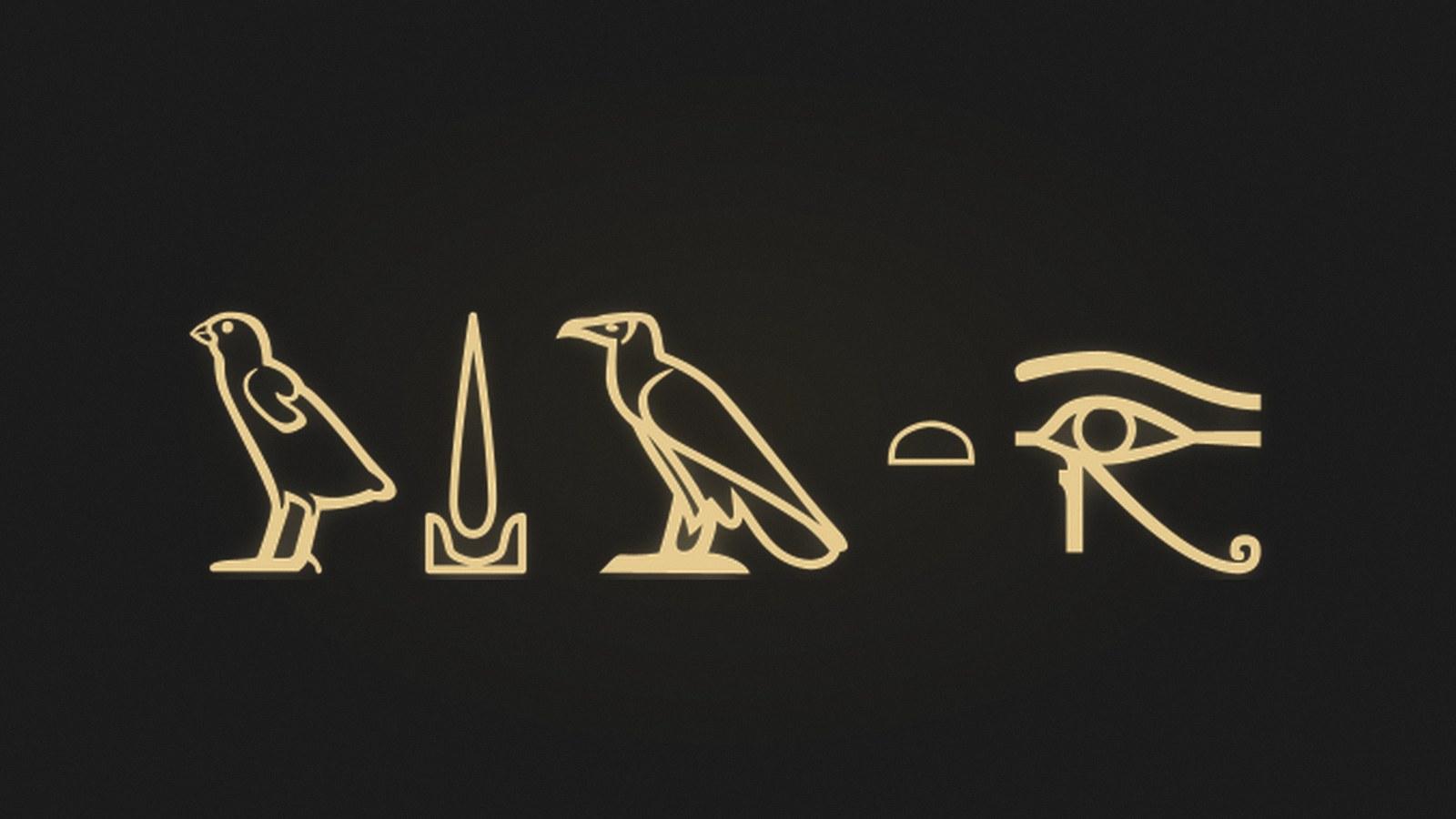
For grain and land, Gardiner says, the Egyptians kept "a more primitive kind of fractions obtained by halving". The grain fractions come from a myth. Seth tore the eye of the falcon god Horus to pieces; the ibis god Thoth "filled" or "completed" it, joining the parts, and so the eye regained its name:
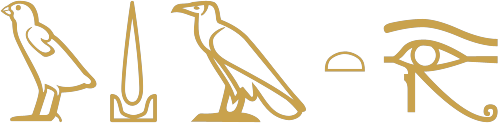
The last sign is the eye itself, which Gardiner's sign list describes as a human eye with the markings of a falcon's head. Each piece stood for a fraction: one part of the white of the eye for ½, the pupil for ¼, the eyebrow for ⅛, the other part of the white for 1/16, and two of the markings for 1/32 and 1/64. They add up to only 63/64: "presumably the missing 1/64 was supplied magically by Thoth". Allen tells the same story and notes that the eye is sometimes called the "Udjat Eye". Both grammars place these signs in hieratic: apart from the sign for ½, Gardiner knows no hieroglyphic example before the Twentieth Dynasty.
Heqat, cubit, aroura and deben
The eye fractions served the heqat, the standard grain measure. Gardiner puts it at a little more than a gallon, 4.54 litres; Allen at 4.8 litres, or 10 hin, the hin being a jar used for liquids. There was also a double heqat and a quadruple heqat, later called the oipe. In the Eighteenth Dynasty the sack held 16 heqat; Gardiner takes it as a change from the Rhind papyrus's sack of 20, while Allen gives the older sack as 10 heqat. In hieroglyphic texts, both grammars note, heqat were counted with ordinary numbers and fractions, as in a line both quote:

Fine gold is the sceptre and the collar of beads. The heqat is the crook, a triangle and a loaf over a measure with grain pouring out, and 88½ is eight hobbles, eight strokes and gs.
Length was counted in cubits, written with the sign met in the thirty-sixth lesson. Gardiner gives the cubit as about 523 millimetres and Allen as 52.5 centimetres, divided into 7 palms or 28 digits, so Gardiner can quote "four cubits, 4 palms and 2 digits". A hundred cubits made a rod, ḫt, and 20,000 cubits the itrw, "river-measure", about 10.5 kilometres.
Land was measured in arouras, stꜣt: a square of 100 cubits each way, roughly ⅔ acre in Gardiner's figure. The half, quarter and eighth of an aroura had names of their own, and smaller parts were counted in "cubits", strips 100 cubits long and 1 cubit deep. Ten arouras were written ḫꜣ, "thousand". Allen explains why: the aroura was thought of as 100 such strips, so ten arouras were a thousand of them.

After ꜣḥt, "field", come two lotus plants, ḫꜣ 2, then the aroura sign over two strokes: literally "thousand 2, aroura 2".
From the Eighteenth Dynasty, Gardiner says, metals were weighed in deben of 10 kite, the deben coming to about 91 grammes:

The deben is a folded intestine over the water line, with a stone slab, and 761 is seven coils, six hobbles and a stroke. Allen adds that the Middle Kingdom deben weighed only 13.6 grammes and had no fractions, and that a twelfth of the deben, the "ring", came before the kite; Gardiner calls the same twelfth a "seal". The next lesson returns to verbs, with the imperfective sḏm·f, "he hears" again and again.