The last lesson put a noun after an adjective to say in what respect it holds, as in "sharp of face". Nouns can stand side by side in other ways too. James Allen counts three relationships that two Egyptian nouns can express in a phrase: apposition, connection and possession. The fourth lesson dealt with possession, the genitive, and passed on Allen's caution that two nouns side by side can also name the same thing, as in sꜣ·k Ḥr, "your son, Horus", or mean "and", as in t ḥnḳt, "bread and beer". This lesson takes up those two, and adds "or".
Two names for one thing
"Apposition", Allen explains, means simply "side by side": two nouns used together to refer to the same thing, as in English "our friend, the dog". Many Egyptian cases are a title followed by a name, such as sš Rꜥ-ms, "scribe Ramose". Alan Gardiner adds that "words in apposition may be separated from one another by other words". A line of Sinuhe reads ꜥr nṯr r ꜣḫt·f, n-sw-bit Sḥtp-ib-Rꜥ, "the god mounted up to his horizon, the king of Upper and Lower Egypt Sehetepibrēꜥ": the king's title and name stand in apposition to "the god", with the rest of the sentence between them. A suffix pronoun can even come first, with the noun after it: "How shall this land fare m ḫmt·f, nṯr pf mnḫ, without him, that beneficent god?"
Gardiner then picks out "a style of apposition common to Egyptian and the Semitic languages", found in three special cases. One names the material a thing is made of: ḥnꜥ ꜥš ḫꜣy(t) wrt, "together with the great altar of cedar", literally "together with cedar, the great altar". Another gives a locality: Tꜣ-wr ꜣbḏw, "Abydos in the Thinite nome", literally "Thinite nome, Abydos". The third is kept for the end.
No word for "and"
Both grammars open the next point the same way. Gardiner: "Egyptian has no special word for 'and'." Allen: "Middle Egyptian had no word for 'and.'" Instead, says Gardiner, "the co-ordination of nouns or adjectives is often effected by direct juxtaposition", just as in t ḥnḳt. In the Shipwrecked Sailor, gm·n·i dꜣbw iꜣrrt im is "I found figs and grapes there", with nothing between "figs" and "grapes". Adjectives work the same way: ṯꜣš·f rsy mḥty is "its southern and northern boundary".
Where the sense needs help, "the repetition of a preposition, a suffix or an adjective may help out the sense". The tenth lesson already met ḥr mw ḥr tꜣ, "on water and on land", with its preposition said twice. Gardiner's examples here are iꜣwt·ṯn prw·ṯn, "your offices and your houses", with the suffix repeated, and this one, with m, "in", repeated:

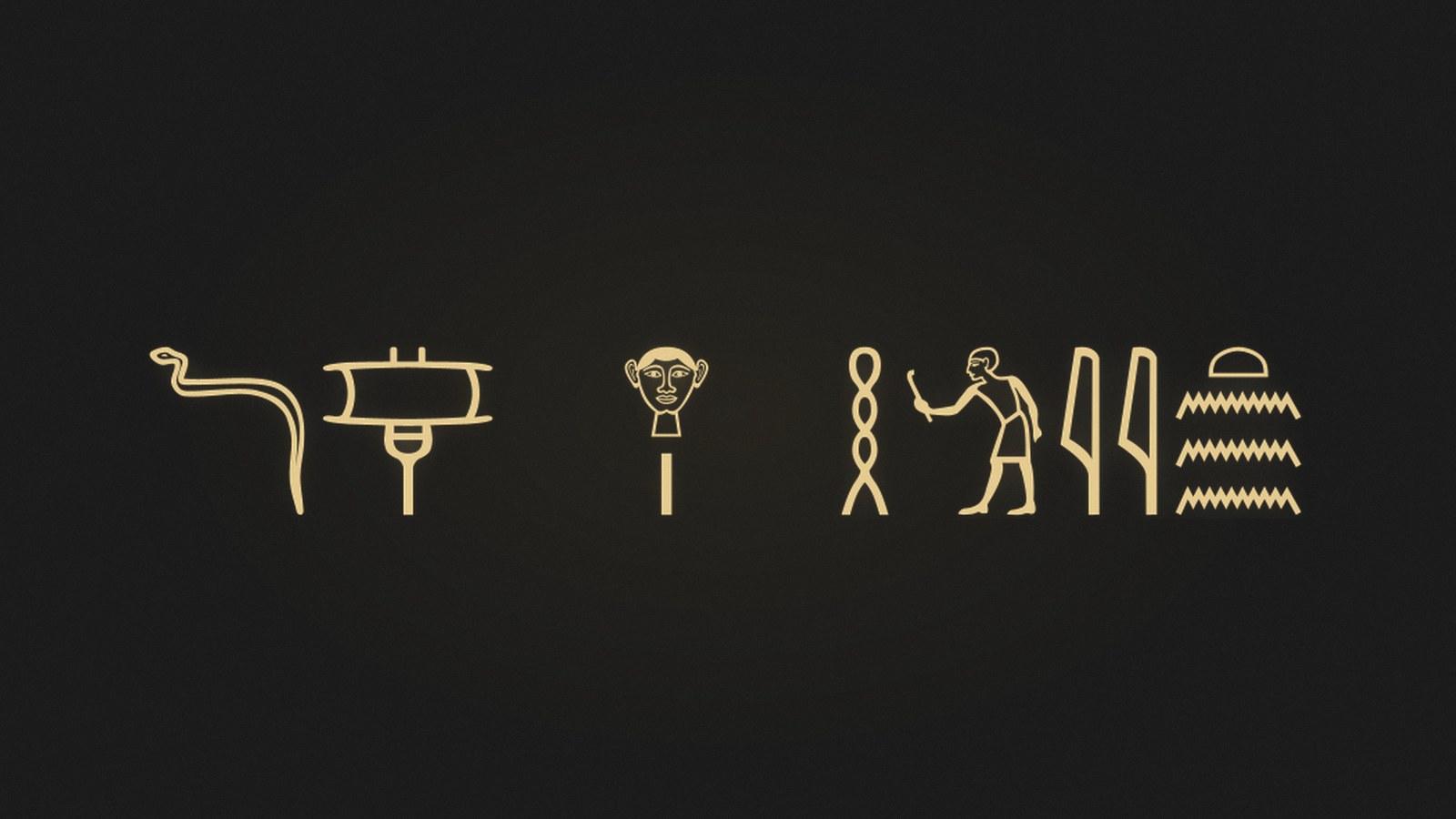
ḫt·i is "my property", with the seated man for ·i. nbt is the nb, "all", of the second lesson, with a feminine t, because Gardiner counts ḫt as feminine when it means "things" or "property". šꜣ, "country", is written with a pool of lotus flowers, and niwt, "town", with a village at a crossroads.
Upon and together with
Two prepositions can also do the joining. "Closely connected words", Gardiner says, "may be coupled by means of ḥr, lit. 'upon'":

ḏꜥ, "wind", ends with a sail, and ḥyt, "rain", with water; between them stands ḥr, the face over a stroke. Gardiner files this use under ḥr "of addition": "wind upon (i.e. and) rain". Allen agrees that the sense of addition lies behind it, and translates "stormwind and rain".
"Or else", Gardiner goes on, ḥnꜥ, "together with", "is employed, especially when the co-ordination is less close". The tenth lesson taught ḥnꜥ as "with" a companion, and Allen says the same meaning of accompaniment underlies this use. Gardiner's example is again from the Shipwrecked Sailor:

msw, "children", and snw, "brothers", both end with a seated man and woman over plural strokes, the sign for people, and each takes its own ·i, "my". Allen's example is ḥꜣty ḥnꜥ smꜣ, "the heart and the lungs", literally "heart together with lungs". Gardiner adds that ḥnꜥ with an infinitive can carry on the ḥr and infinitive of the nineteenth lesson: iw·f ḥr wnm .... ḥnꜥ swri, "he eats .... and drinks", literally "with drinking".
Saying "or"
"'Or', like 'and', may be left unexpressed", Gardiner says. ṯsw nb ḥꜣty-ꜥ nb is "any commander or any prince", and "here the repetition of nb assists the meaning"; a repeated preposition or suffix can do the same. Allen agrees that "or" is usually expressed just by putting one noun after the other: ḏbꜥ sꜣḥ, "a finger or a toe", literally "finger, toe".
Gardiner also gives "a special word for 'or'", r-pw, "which is placed after the last of the alternatives". His example repeats a preposition as well, m, "as":

nb, "lord", ends with a seated man, and ḫnms, "friend", with a man holding a stick and a seated man; its nm is written with a tall butcher's knife. r-pw is the mouth over a stroke, then the stool over the coil. Allen describes r-pw as a phrase "meaning something like 'whichever'", which occasionally marks "or" more clearly by standing "after the second noun": s st r-pw, "a man or a woman", literally "man, woman, whichever". Gardiner notes one case where it follows each of two alternatives.
Gardiner's third special case of apposition, with measures and numbers, as in ḥnḳt, ds 2, "beer, two jugs", that is, two jugs of beer, leads into the next lesson: fractions, weights and measures.