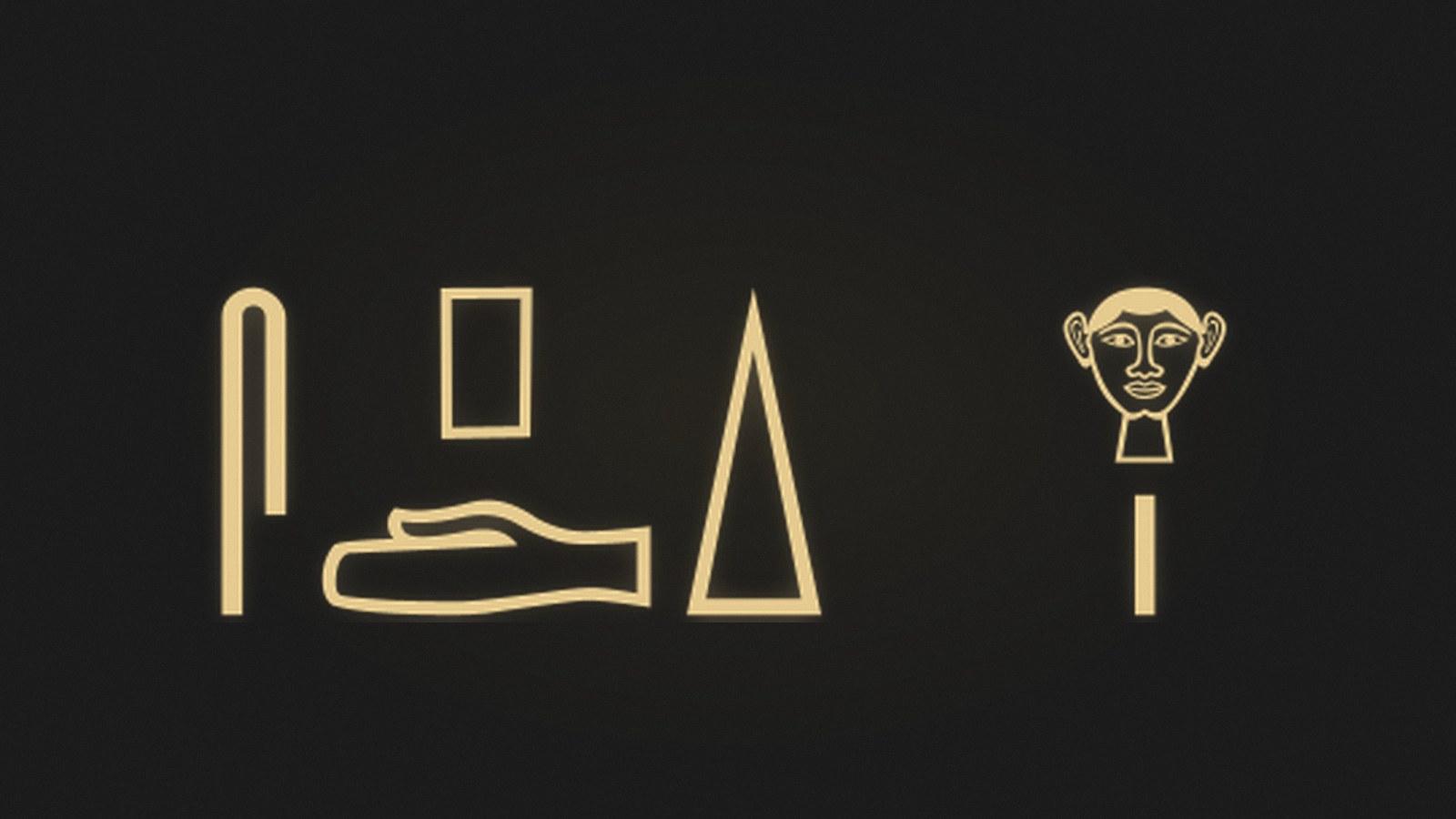
The thirty-ninth lesson used verb forms as nouns, as in "what he did". Adjectives can be nouns too: the second lesson met nfrt standing alone as "beautiful woman". James Allen adds that, like other nouns, an adjective used as a noun can be part of a longer phrase, and that one very common case is a genitive, the "of" of the fourth lesson, with the adjective first: nfr ḥr, "good of face", literally "a good one of face". Egyptologists call it the nfr ḥr construction, and Allen notes that nfr ḥr itself is an Egyptian expression for "kind".
Alan Gardiner describes the same pattern from the other end. Nouns, he says, "may further be employed to qualify adjectives or adjective verbs, like the accusative of respect in Latin or the genitive in Arabic; a very common use." The noun says in what respect the adjective holds: good in face, sharp in face.
Sharp of face
Gardiner's first example describes a clever person:

spd, "sharp", is the folded cloth, the stool over the hand and the thorn; ḥr, "face", is the face over a stroke. Gardiner explains the image in his introduction. Egyptian described qualities of mind and feeling "by reference to the physical gestures or expressions by which they were accompanied", so "cleverness" is "sharpness of face (sight)", and "liberality" is "extension of hand".
Such a phrase can follow a noun and describe it, like any adjective:

nṯr·ṯn is "your god", with the plural "your" of the third lesson; bnr, "sweet", is a single sign that Gardiner's sign list describes as perhaps a sweet-tasting root, and mrwt is "love". Gardiner's third example has an adjective verb: rḫ·n·f ꜣḫ·i n·f ib, "he knew I was serviceably minded towards him", literally "that I was beneficial to him in heart".
The twentieth lesson met the same use in a command. In m ꜥꜣ ib·k, "do not be puffed up", which Gardiner renders literally "great as to thy heart", he takes ib·k as saying only in what respect, and he refers back to this use. Allen makes the heart the subject there, but still compares the pair to the nfr ḥr construction: "don't get big of your heart", like English "big-headed".
One who has many sheep
Allen explains how the two words share the work. The adjective refers to the person or thing being described, and the noun to "something that the person or thing owns or has". In his words, "Egyptian assigns the adjectival quality to the owner rather than the thing owned, whereas English normally does the reverse." So a man might describe himself like this:

Literally it is "many of sheep". ꜥšꜣ, "many", is the lizard, then a papyrus roll over three strokes; the strokes, Allen says, are a determinative for "many". srw, "sheep", ends with a ram and plural strokes. Allen adds that the construction can normally be translated with an English "have", and he lists it beside the nb, "owner", of the fifteenth lesson. His example from Sinuhe puts it after the ink, "I", of the twelfth lesson: ink ꜥšꜣ mrwt, "I have many serfs", literally "I am many of serfs".
The same shape gave the thirty-fifth lesson its superlative, wr n wrw, "the great one of the great ones". There the second noun names the others he stands out among; here it names what the person has.
Kings and gods
The construction suits epithets, and the royal names of the fourteenth lesson are full of it. In Gardiner's second titulary, of Tuthmosis III, the Two Ladies name is "Enduring-of-kingship-like-Rēꜥ-in-heaven" and the golden Horus name is sḫm pḥty ḏsr ḫꜥw, "Powerful-of-strength, holy-of-diadems". His paraphrase uses both kinds of English: this king is "the golden Horus who is powerful of strength and whose diadems are holy". Allen's example is Amenemhat III, whose Horus name ꜥꜣ bꜣw, literally "great of impressiveness", means "He whose impressiveness is great". Gods have such epithets too: Allen gives Ptah of Memphis as rsy inb·f, "he who is south of his (city's) wall", with the rsy, "southern", of the sixth lesson.
With n before the noun
When the noun has a suffix pronoun, Gardiner says, the indirect genitive is sometimes used in the same way, with the genitival adjective between the two words:

For "with" Gardiner adds "lit. of". iḳr, "excellent", describes the scribe, and n ḏbꜥw·f, three fingers and the viper of ·f, says where the excellence lies. Allen quotes the same words from another text as "a scribe skilled with his fingers", literally "a scribe, a skilled one of his fingers". Gardiner's second example is feminine:

nfrwt, "beautiful ones", is feminine plural, so the "of" is nt. The line describes twenty women; in Gardiner's print a small m stands in front, and he translates "who are beautiful of body, lit. as beautiful ones of their members". Allen renders the phrase "those who have beautiful bodies".
Here the grammars part company. For Allen all of these are genitives with the adjective as the first noun, direct as in nfr ḥr or indirect as in sš iḳr n ḏbꜥw·f. Gardiner files the plain construction under the heading "Adverbial uses of nouns", and he hesitates over the masculine examples: "it is not quite certain that n is the genitival adjective", since it "might be the preposition n".
The next lesson looks at how Egyptian joins words with "and" and "or".